Homebrew • DM Tips • Ritual at the Table
Ritual at the Table: The Sound Beneath the Story
Music, Atmosphere, and the Emotional Architecture of Play
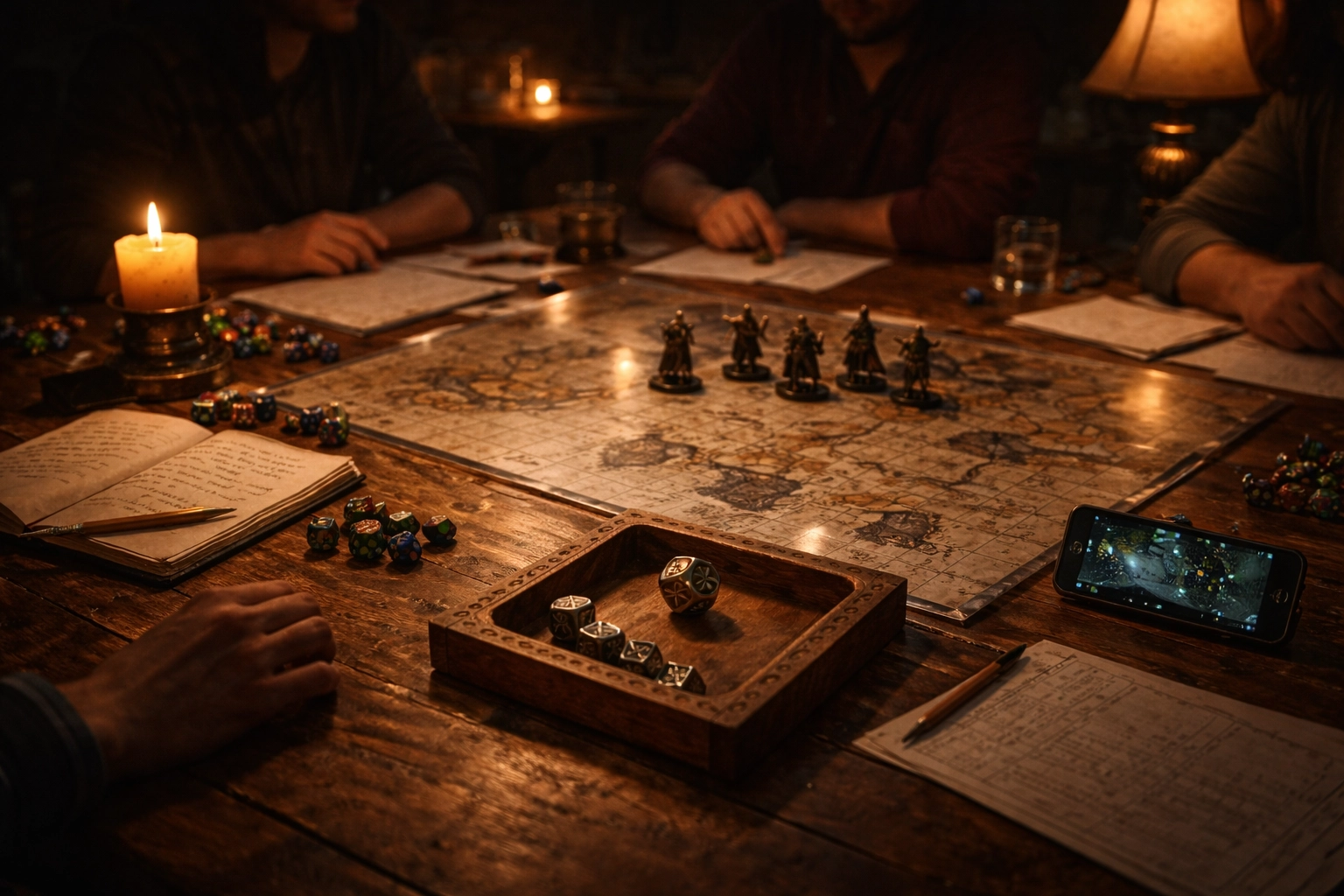
There is a moment when the music stops, not fades; not drifts into something softer. Stops.
“The soundtrack of a game isn’t background noise. It’s emotional architecture.”
At the table, that silence lands like a held breath.
I’ve watched it happen in the middle of a session when players were joking a moment before. Dice had been rolling. Plans were forming. Someone was mid-sentence. Then the track ended, or I paused it deliberately, and suddenly the room felt different.
People leaned forward. No one spoke for a second. The silence itself became part of the story.
That’s when I realized something important: the soundtrack of a game isn’t just background noise. It’s emotional architecture. It shapes the room long before the players know why.
And like everything else in long-form campaigns, when used intentionally, it becomes ritual.
Sound as Emotional Framing
In film, music tells the audience how to feel about what they’re seeing. A hopeful melody signals triumph. A low drone warns of danger. Silence makes a moment feel intimate or devastating.
At the tabletop, sound works the same way, but with an important difference.
Players aren’t watching a story; they’re inside it.
Music doesn’t dictate their emotions. It frames their expectations. It sets the emotional temperature of the room. Over time, those cues become familiar, predictable in the best way.
A certain track begins, and players immediately know something dangerous is coming. A familiar tavern theme plays, and shoulders relax. Plans get made. Laughter returns.
These patterns aren’t accidental. They build over weeks and months of play. In long-form campaigns, recurring sound becomes a form of memory.
Players may not remember the exact details of every encounter, but they remember how the room felt.
“Players may not remember every encounter, but they remember how the room felt.”
Atmosphere: The World in the Background
Most of the time, sound should do its work quietly.
Ambient audio, rain against windows, wind through trees, the low murmur of a tavern crowd, exists to give the imagination something to rest on. It fills the empty spaces between words. It helps the room feel less like a dining table and more like somewhere else entirely.
During stakeouts at Stoutfellow Farm in our Dragon Heist campaign, the party spent long stretches simply waiting. Watching fields under moonlight. Listening for movement. Nothing dramatic happened for minutes at a time, but the ambient track carried the moment. Night insects. Rustling wind. A distant owl call.
“Atmosphere doesn’t draw attention to itself. If it does, it’s probably too loud.”
Those small sounds made the stillness feel real.
When something finally moved in the dark, when the possessed scarecrows emerged from the fields, the players were already leaning forward.
Atmosphere doesn’t draw attention to itself. If it does, it’s probably too loud or too busy. Its job is simply to remind the room that the world continues beyond the edges of the table.
Emotional Underscore: The Sound of Stakes
Where ambient sound fills space, music shapes emotion. Combat music signals urgency. Tense orchestral strings warn that something is wrong. Slow piano can turn a conversation into something fragile and intimate.
But the real power of music emerges when it becomes familiar. In Voxels & Valor, played entirely over Discord, certain tracks have taken on lives of their own. When battle music begins to swell, players straighten in their chairs. Jokes taper off. Strategy sharpens.
No one announces that combat has begun; the music tells them.
Over time, these tracks become emotional shorthand. They build associations between sound and story. A certain theme might come to mean danger. Another might belong to a particular villain. A third might signal safety, the quiet comfort of returning to town.
Used carefully, those associations grow stronger every session. Used carelessly, they wear out quickly.
The Danger of Over-Scoring
Music is powerful, which means it’s easy to overuse. One of the earliest mistakes I made as a Dungeon Master was trying to score every moment. Every conversation had background music. Every quiet scene had some kind of emotional track beneath it.
“If every moment is dramatic, none of them are.”
Instead of deepening immersion, it flattened everything. If every moment is dramatic, none of them are.
Players stop noticing the music. Or worse, they begin to fight against it, joking over the soundtrack or tuning it out entirely. The lesson took time to learn.
Sound is most effective when it’s selective. A campaign doesn’t need a soundtrack playing constantly. Sometimes the best choice is restraint, letting a scene unfold without musical framing. That absence creates contrast, and contrast is what gives sound its power.
The Ritual of Silence
“The most powerful sound at the table
is often the one that isn’t there.”
The most powerful sound at the table is often the one that isn’t there. Silence can hold tension better than any track.
When Venomfang unleashed his breath weapon against Voxels & Valor, the Discord channel fell completely quiet. The shock of the moment didn’t need music. It didn’t need emphasis.
I let that silence linger. Forty-five seconds. Maybe a full minute.
No one rushed to fill the space. That pause became part of the scene.
The same thing happens at physical tables. When the room goes quiet, truly quiet, players instinctively recognize that something important is happening.
Silence becomes ritual. It signals weight.
Sound at the Digital Table
If texture anchors ritual at a physical table, sound may be the strongest pillar in digital play. Online games lose many tactile elements. There is no shared table surface. No dice tray echoing across wood. No shifting light in the room.
But sound remains. In Voxels & Valor, music and voice cadence carry much of the atmosphere that physical space would normally provide. A change in tone becomes more noticeable. A shift in soundtrack feels more significant.
Digital tables rely heavily on audio to maintain immersion. Which means audio disruptions, a sudden microphone crackle, a track that ends abruptly, a volume spike, can break immersion faster than almost anything else.
But when sound is handled well, digital sessions can still develop their own rituals: the moment when music starts, the moment when it stops., the moment when everyone goes quiet at once.
What This Is Not
Sound design at the table isn’t about cinematic perfection. It isn’t about elaborate playlists or expensive audio equipment, and it isn’t about playing music constantly.
A Dungeon Master doesn’t need to become a film composer to create atmosphere. Most of the time, one well-chosen ambient track and a few reliable pieces of music are enough.
What matters is consistency, intention, repetition. Those small choices accumulate over time, and eventually, they become ritual.
The Sound That Stays
Players rarely remember specific tracks months later, but they remember the feeling. They remember the quiet tension of a stakeout under moonlight, they remember the sudden swell of music when battle began, they remember the silence after something terrible happened.
Sound shapes those memories in ways that are difficult to see in the moment, but when the campaign ends, when the story finally closes, those emotional echoes remain.
“Sound doesn’t just accompany the story. It teaches the table how to feel.”
And sometimes, all it takes is hearing a familiar piece of music again to be transported instantly back to the table; back to the room; back to the moment when the dice were rolling and the story was alive.
Next in the series: The Scent of Story.
Because sometimes the strongest memories of a campaign aren’t sounds at all.
Sometimes they’re the faint trace of something in the air — a scent that means, without a word spoken, that the adventure has begun.