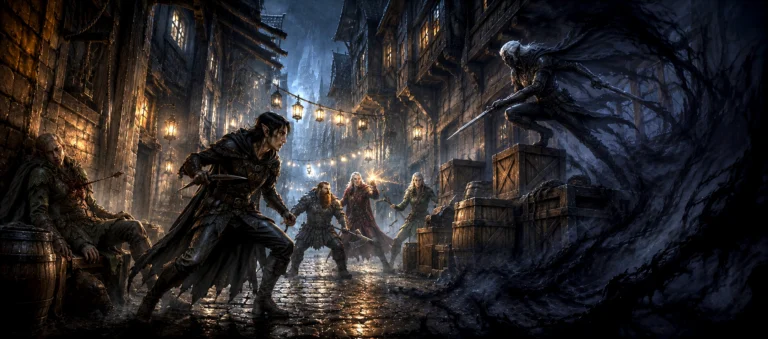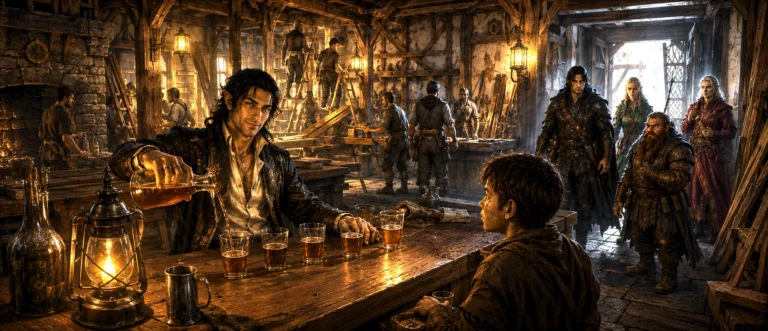
Homebrew • DM Tips • Ritual at the Table
Ritual at the Table: Texture and the Weight of the World
How Physical Tools Shape Consequence at the Table
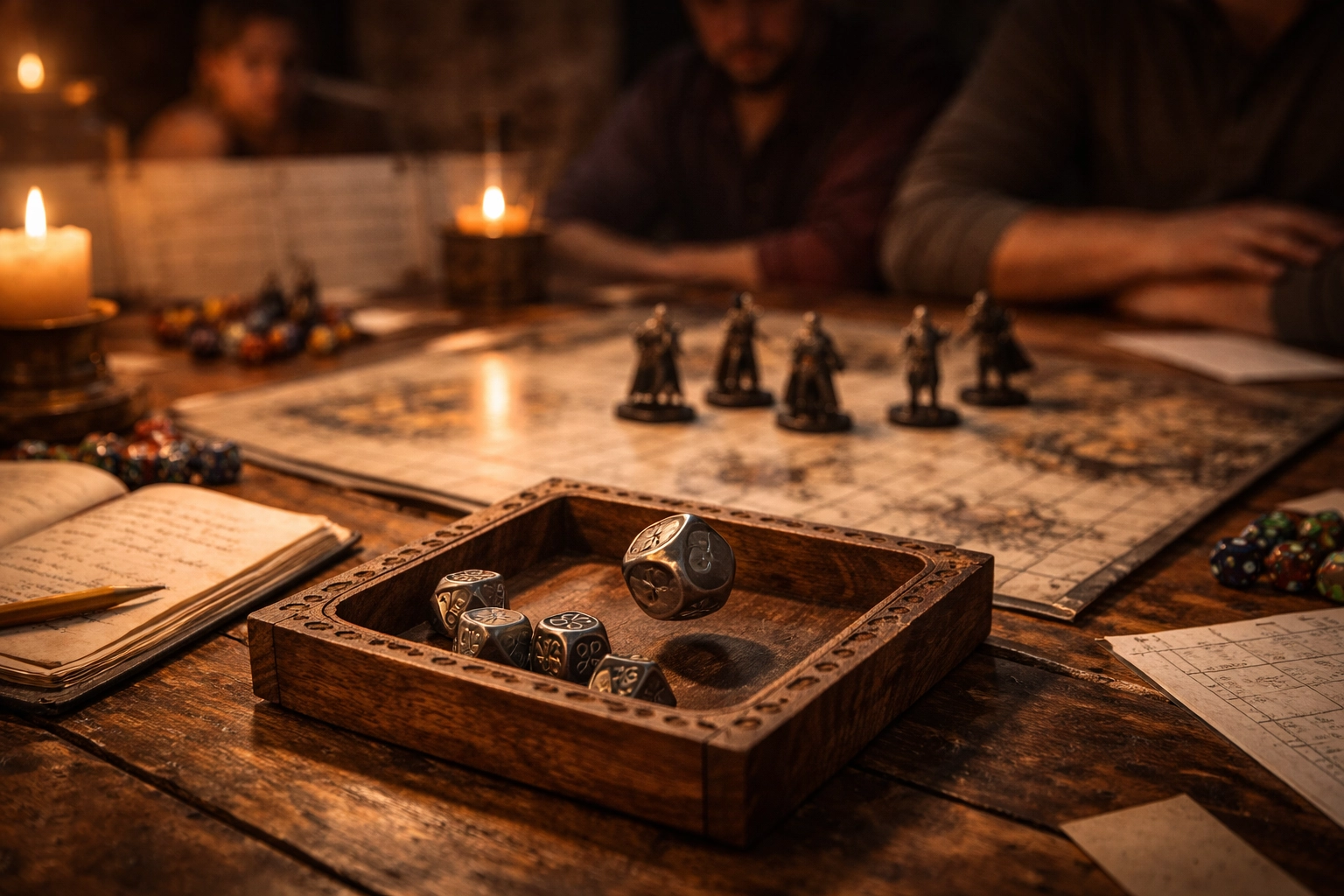
Before the music swells, before the lights dim, before a candle burns.
Someone rolls the dice.
The Shot That Wasn’t Supposed to Land
Zend shouldn’t have made that shot.
Long range, disadvantage, a fleeing villain gaining distance. I had stacked everything I reasonably could in Iarno’s favor. Not to cheat the players, but because sometimes a villain should escape. Sometimes the story needs a shadow to retreat and return.
Zend didn’t hesitate. He drew; he loosed. The die struck the tray.
There’s a particular sound when a heavy roll lands cleanly, a contained crack of impact, wood echoing against wood, the vibration carrying just long enough to silence the table.
No one spoke, but we all leaned in. The result stood, and in that moment, the campaign changed direction.
“The die struck the tray, and in that sound, the campaign changed direction.”
Not because of narrative brilliance, not because of clever design. Because of a roll, because the roll had weight.
The Comb in the Silence
Later, in a very different scene, Lazmr paused at the edge of Agatha’s hut. The questioning was done. The party had what they needed. They could have left in triumph.
Instead, he removed Sister Garaele’s silver comb from his pack, walked back to the table in the center of the room, and placed it down.
Not dramatically, not forcefully, but gently.
Metal touched wood. No music; no narration. Just the soft, unmistakable sound of something physical entering the space between characters.
Agatha, and the players, were stunned. It was one of the quietest moments of the campaign. And it worked because the table held it. Texture gave it gravity.
“Texture gives consequence weight.”
Texture Creates Consequence
In the original post, I wrote that ritual begins with what we touch. Texture is the first pillar because it is the most immediate; the most undeniable. The one you cannot abstract away. Before sound frames emotion, before light narrows focus, before scent anchors memory, there is the physical act of play.
Dice in hand, paper under pencil; Miniatures placed on a map.
Texture does something subtle to the brain. It assigns seriousness, it assigns weight, it assigns consequence.
A lightweight die skittering across a bare table feels different than a metal die striking a contained tray. A roll that echoes outward invites chaos. A roll that lands inside a boundary invites attention.
At my table, the tray has become the line between accident and intention.
The Sound of the Roll
I didn’t always use a dedicated tray. For months, dice scattered across whatever surface was available. They hit books, knocked over minis, skittered under character sheets. It was lively. It was casual. But when we introduced a consistent rolling space, and later, a tower, something shifted. The roll became ceremonial.
There’s a rhythm now. A player reaches. A die drops. The sound lands contained. Everyone looks.
“A roll that echoes invites chaos. A roll that lands contained invites attention.”
The tower adds anticipation, the rattle inside, the half-second delay before the result appears. It builds tension in a way open-table rolling never quite did. That containment matters: it turns randomness into ritual.
And when that ritual repeats weekly across months of play, the sound itself becomes associated with consequence. The tray isn’t just practical, it’s psychological framing.
Weight and Authority
“Texture shapes expectation; expectation shapes emotion. Emotion shapes memory.”
Not all dice feel the same and, whether we admit it or not, players treat them differently.
Heavy metal dice carry authority. When someone brings them out for a pivotal moment, a death save, a final strike, a spell slot that will decide the encounter, the physical heft changes posture. It slows the roll. It demands intention.
Resin dice tell a different story. They catch light, they hold color and theme, they become associated with characters, with schools of magic, with moods.
At my table, certain sets have quietly become tied to certain moments. A player will reach for a specific set when they want the roll to matter. Not because the math changes, but because the feel changes.
Texture shapes expectation; expectation shapes emotion. Emotion shapes memory.
Texture Beyond Dice
Dice are only the beginning. For Dragon Heist, I use maps from Heroic Maps. I lay a sheet of Plexiglass wrapped in dry erase film over the map and minis sit directly on the surface. Players can draw spell effects, movement paths, improvised terrain, and then wipe it clean without damaging the printed art beneath.
The physical layering matters. The map feels permanent, the markings feel temporary. The world exists and the chaos passes over it.
On the wall, a dry erase board tracks initiative. Names written. Erased. Rewritten. A visible reminder of time passing and turns rotating. Combat becomes tangible.
Then there are the handouts.
- The invitation delivered to each character.
- The Customs form stamped and folded for each to complete.
- The Code Legal passed out, repeatedly to some, and physically present at the table.
- Volo’s Enchiridion given by the author, placed in the players’ hands.
- Even Strahd’s Deck of Horrors laid out in uneasy silence. A dark gift from an unknown foe.
Paper weight; ink texture; fold lines. These things are not props; they are anchors.
When a player holds something from the world in their hands, the world stops feeling theoretical.
What I’ve Learned After Months of Play
Maple brings a full set of Dr. SmellyBones’ scented dice to every session. He chooses the scent intentionally for each roll. It began as novelty, now it’s ritual.
We haven’t played long enough to see wear patterns on trays or towers yet. But I’m watching for it. Scratches. Dents. Polishing on certain edges. Evidence of repetition.
Because that’s what ritual leaves behind. Evidence.
The longer a campaign runs, the more the physical tools begin to absorb story. They become part of the campaign’s archaeology: the tray that heard Zend’s impossible shot, the map that bore the marks of a desperate defense, the handout that was passed around with shaking hands.
Texture records memory.
Practical Takeaways for Your Table
If you want to experiment with tactile ritual, start simple:
- Choose one consistent roll surface and commit to it.
- Let heavy dice be used for heavy moments.
- Allow silence after important rolls. Don’t rush narration.
- Use physical handouts when stakes rise.
- Make the act of rolling intentional, not incidental.
“Repetition turns object into ritual.”
You don’t need luxury tools, you need consistency. Repetition turns object into ritual.
Before Light. Before Sound.
Texture is where ritual begins. It is the first signal that something matters; it is the boundary between casual gathering and shared story.
When Zend’s arrow changed the course of a chase, it wasn’t just because the die rolled high, it was because the roll felt final.
When Lazmr placed that silver comb on Agatha’s table, it wasn’t just narrative restraint, it was the quiet authority of something physical entering the space.
Before music swells, before lights dim, before a candle burns. Someone rolls the dice.
And if we let it, that sound can carry the weight of the world.
Next in the series: Light as Liturgy, how illumination shapes focus, fear, and presence at the table.