Homebrew • DM Tips • Ritual at the Table
Ritual at the Table
Why Sensory Design Matters in Long-Form Play
There is a moment before every session where the room changes. It’s subtle.
Dice are set down. Chairs scrape into position. A notebook opens. Someone reaches for a drink. The pre-game chatter lingers just a little longer than it should, and then something shifts.
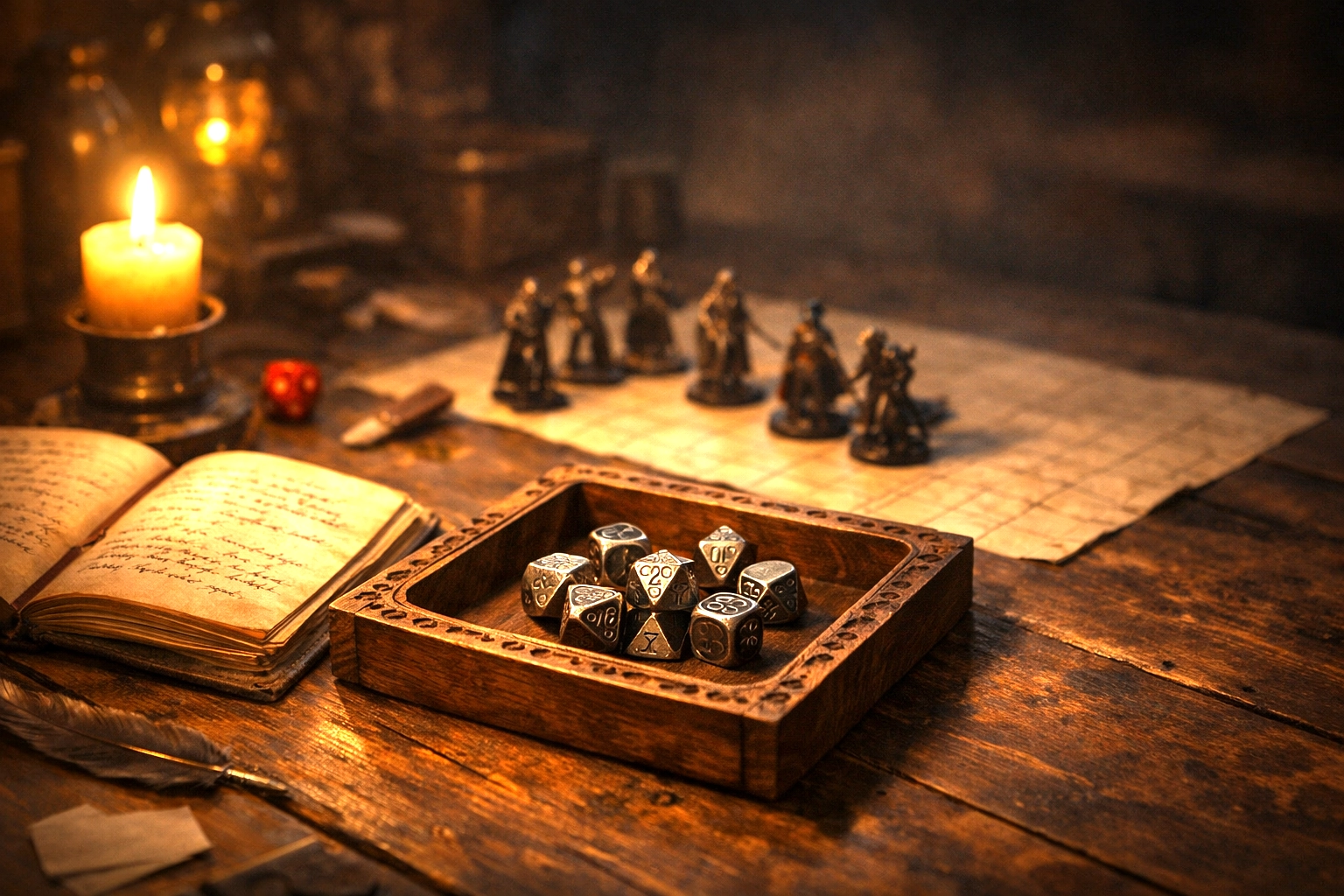
At my Dragon Heist table, it often happens when the dice tray is set in the center. The sound is unmistakable. Wood on wood. Weight placed with intention.
My players don’t announce that we’re beginning, but they lean forward. That lean is ritual.
“That lean is ritual.”
And I’ve come to believe that ritual, not rules, not prep, not even plot, is what transforms a game into a world.
Ritual, not rules, not prep, not even plot, is what transforms a game into a world.
Tabletop as Ritual
We gather weekly: same table, same people, same characters, same unfinished story waiting patiently where we left it.
We dim lights, we adjust seats, we roll dice.
Over time, those repeated actions become more than logistics. They become cues, signals, transitions. They tell the brain: we are leaving the ordinary room and entering somewhere else.
In my Waterdeep campaign, that transition became visible during the Lif haunting at Trollskull Manor. The first night the players slept in the tavern, the room felt playful, curious. Haunted in a storybook way.
By the time the cursed troll skull rose and lashed out, something else had taken hold. The players weren’t laughing anymore. They weren’t checking phones. The air felt tighter.
Nothing magical had happened in the real world, but the lights had dimmed. The table was quieter. The dice sounded heavier in the tray. The moment had weight.
That weight is not accidental; it is built. And when built intentionally, it becomes ritual.
Why Ritual Matters in Long-Form Campaigns
A one-shot can survive on novelty. A clever hook, a dramatic twist, a memorable combat.
Long-form campaigns demand something deeper. They demand continuity; they demand emotional return.
When we played through the Fireball incident in Dragon Heist, when shock turned personal and grief became motivation, the emotional impact wasn’t just narrative. It was cumulative. Weeks of shared space, weeks of recurring table rhythms, weeks of familiar sensory cues telling the players, “This place matters.”
When Lazmr paused in Agatha’s hut, removed Sister Garaele’s silver comb, and placed it gently on the table before leaving, that silence lingered. Not because of mechanics. Not because of combat stakes, but because the room had grown still.
No music. No chatter. Just the soft thud of metal on wood. The table held the moment.
Ritual makes the table capable of holding moments like that. Without ritual, everything resets every week. With ritual, memory compounds.
With ritual, memory compounds.
The Pillars of Ritual at the Table
This series explores four primary sensory anchors that shape long-form immersion. Not because they are mandatory, but because they are powerful.
I. Texture: The Weight of the World
Before the soundtrack, before the lighting shift, before the candle burns, someone rolls the dice.
Texture is the most immediate ritual. The physicality of play. The sound of a heavy die striking wood. The contained echo inside a dice tray. The resistance of thick paper beneath a pencil.
When Zend loosed that long-range arrow at a fleeing Iarno, a shot I quietly hoped would miss, the roll felt heavier than usual. Disadvantage. Distance. Stakes rising.
The die struck the tray, and in that sound, something final settled. Texture gives consequence weight. It reminds us this world has gravity.
Texture gives consequence weight.
II. Light: Focus and Shadow
Light is attention. Bright overhead lighting encourages conversation, laughter, casual posture. Lower the lights, even slightly, and something shifts. Faces turn inward, voices lower. Players watch more closely.
During our descent into the Xanathar hideout beneath Waterdeep, the lighting was tighter. Warmer. The room felt enclosed.
When danger escalates, light can narrow. When safety returns, it can open.
Light is not decoration; it is directional storytelling.
Light is not decoration; it is directional storytelling.
III. Sound: The Emotional Undercurrent
Music is emotional shorthand. A low ambient track can make a room uneasy before a single word is spoken. Silence can amplify tension more than any soundtrack.
In Voxels & Valor, even played over Discord, audio cues still matter. The swell of battle music. The drop into silence before a reveal. The familiar town theme that signals rest.
Sound doesn’t just accompany story, it frames expectation. Used consistently, it becomes Pavlovian. Players learn to feel before they understand why.
Sound doesn’t just accompany story,
It frames expectation.
IV. Scent: Memory and Association
Scent is the most primal pillar. It bypasses logic and speaks directly to memory.
I didn’t begin experimenting with scent intentionally. It began casually; a candle lit for atmosphere. But over time, I noticed something strange. The scent itself became associated with the campaign.
Light that candle, and players settle faster. They’re home.
Scent is subtle, easy to overdo. But when used gently and consistently, it becomes a bridge between weeks, between months, between ordinary life and story.
What This Is Not
This series is not about turning your table into a stage production. It is not about expensive upgrades; it is not about aesthetic gatekeeping.
Good Dungeon Mastering does not require ambient playlists, curated lighting, or artisan accessories. This is not a prescription.
What This Is
It is an exploration of intention. This is a study of how repeated sensory cues shape memory and presence. It is field-tested across campaigns that run for months and years. This is about how tools live at the table, how they wear, how they sound, how players respond over time.
Ritual at the Table is not about spectacle, it is about consistency.
The Digital Table: A Fifth Pillar?
Voxels & Valor lives in a different space: Discord calls, digital maps, shared screens instead of shared wood grain. And yet, ritual persists.
Microphone checks become gathering cues, background music shifts tone. The cadence of voices signals when things are about to turn.
The tactile pillar shifts, but the others remain.
Perhaps there is a fifth dimension to explore: How ritual translates when physical space disappears.
Can lighting be simulated digitally? Will sound carry more weight when texture is absent? Can shared rhythm replace shared objects?
The digital table deserves its own reflection, and it may well become its own chapter.
Why Now?
Because I’ve watched what happens when ritual goes unexamined. Sessions blur together, moments lose sharpness, impact fades faster than it should.
But when ritual is intentional, when texture, light, sound, and scent are aligned, something remarkable happens.
Players lean forward, they remember, they return. The table becomes more than furniture; it becomes a threshold.
The table becomes more than furniture; it becomes a threshold.
This series begins with what we touch.
Next: Texture and the Weight of the World.
Because before the music swells, before the lights dim, before the candle burns, someone rolls the dice.
And the world begins.