Dragon Heist • DM Diary • Trollskull Manor
Building a Living Neighborhood
Played: October 24, 2025
How I Turned a Single Tavern into the Emotional Heart of Waterdeep
There’s a moment in many Waterdeep: Dragon Heist campaigns when Trollskull Manor stops being a reward and starts becoming a responsibility.
That moment matters. Because if Trollskull Manor is just “the player base,” then Trollskull Alley risks becoming nothing more than a loading screen between quests. A collection of shop names the players forget five minutes later.
I didn’t want that.
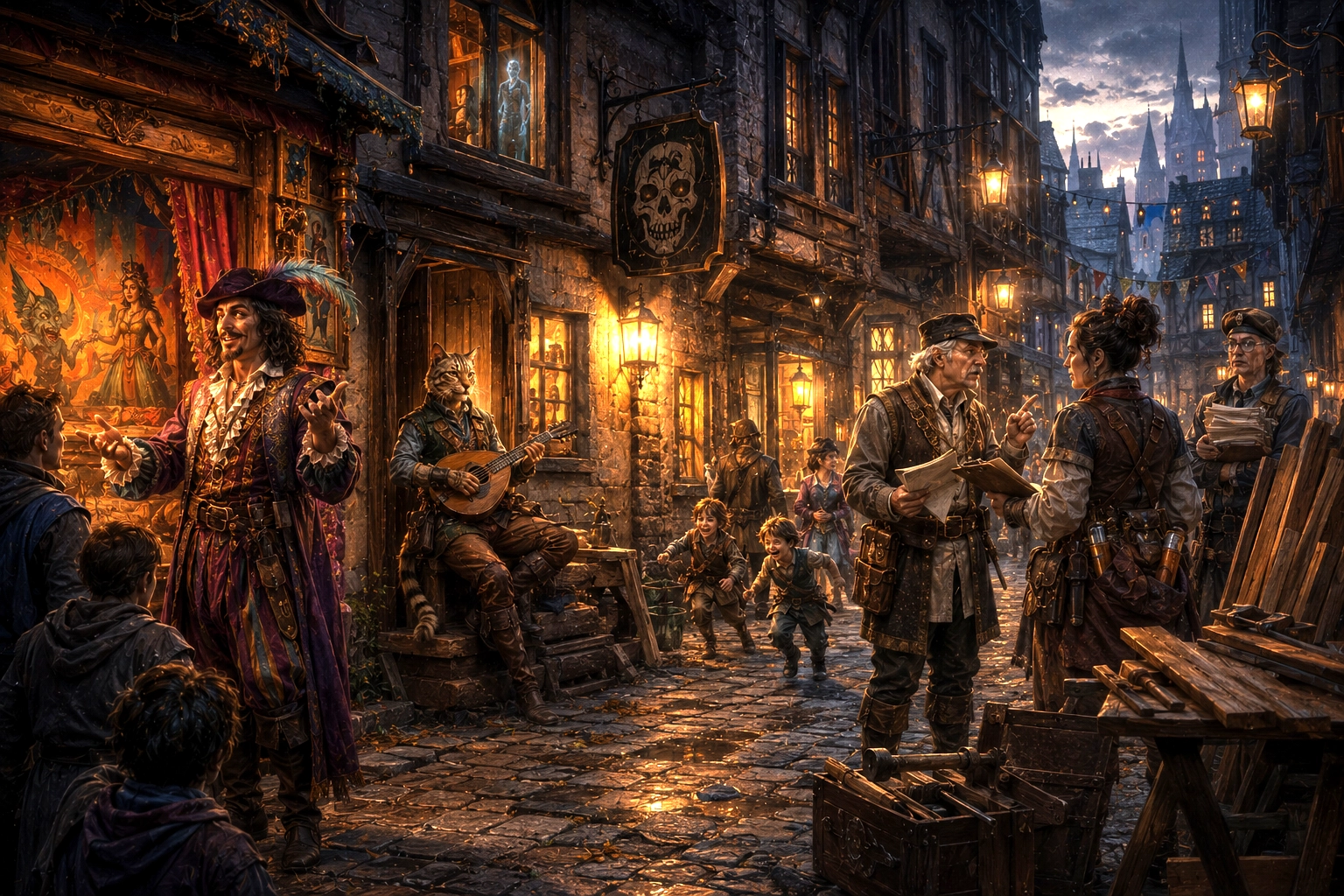
I wanted the Alley to feel alive. I wanted it to breathe. I wanted the players to know what the bakery smelled like in the morning, which shopkeeper was hiding secrets, who waved when they passed, and which rival tavern owner glared from across the street every time they carried lumber into the Manor. Most importantly, I wanted Trollskull Alley to become home.
By the time session 28 rolled around in my campaign, the Alley had transformed from a map location into a functioning neighborhood ecosystem full of relationships, gossip, favors, tensions, humor, horror, and community investment. The players weren’t just adventuring in Waterdeep anymore, they were becoming part of it. And honestly? That changed everything.
NPC Design Philosophy: Every Shop Needed a Soul
When designing neighborhood NPCs, try giving each one:
- A public role
- A private emotional life
- A relationship to the neighborhood
- Opinions about the party
- Relationships with other NPCs
That final point is crucial. NPCs stop feeling like quest dispensers when they know each other outside the players’ presence.
The Core Philosophy: Every Shop Needed a Soul
One of the earliest decisions I made was that every major business in Trollskull Alley needed more than a single defining trait. Not “the instrument guy,” or “the theater owner.” Not “the guild contact.” A soul.
That meant each recurring NPC needed:
- A visible public role
- A private emotional life
- A relationship to the Alley itself
- Opinions about the party
- And ideally, relationships with other NPCs
That last part is the secret sauce. A neighborhood only feels alive when people know each other independently of the players. So instead of isolated quest dispensers, the Alley became interconnected.
Murgo Bumblestout wasn’t just a tailor; he was quietly tied to the Harpers. Mistofer Carlowe wasn’t just theatrical flair, he became part artist, part emotional anchor, part neighborhood gossip engine. Rolls Stone evolved into a laid-back musical presence whose scenes could swing from comedy to sincerity without warning.
Even the guild representatives became recurring personalities instead of faceless tax collectors. Colera Vhalantrae’s guild inspection wasn’t just bureaucracy, it became a performance.
That mattered more than I expected. Because players remember people, not lore dumps.
“A neighborhood only feels alive when people know each other independently of the players.”
The Mistake I Wanted to Avoid
One of the easiest traps in urban campaigns is overbuilding the city while underbuilding the street. Waterdeep is enormous. It has centuries of lore, endless factions, iconic locations, and enough canon to drown a campaign in exposition. But players rarely emotionally attach to “the city.”
They attach to the bartender who remembers their drink, the kid who sleeps in the alley outside, the neighbor who drops by unannounced, or the rival who keeps filing complaints with the Watch.
That’s why I intentionally zoomed inward during this arc. Instead of constantly pulling the party across Waterdeep, these sessions repeatedly returned them to Trollskull Alley between adventures, faction missions, and horror beats.
The Alley became a narrative hearth. And hearths matter in horror campaigns.
Using Repetition to Create Familiarity
DM Lesson: Slow Down the Street
One of the biggest mistakes in urban campaigns is moving too quickly between “important” events.
Neighborhood attachment comes from repetition:
- familiar shopkeepers,
- recurring routines,
- small conversations,
- and scenes with no immediate plot reward.
If players only visit Trollskull Alley between quests, it stays a location. If they live there emotionally, it becomes home.
One of the biggest lessons I learned during this stretch of the campaign was this: Repetition creates emotional realism.
Not every session needs a revelation. Sometimes players just need to pass the same neighbors, hear the same bells, argue with the same guild officials, and laugh at the same running jokes. That consistency builds belonging.
By the time Soukaev and Naska arrived for inspections, the players already understood the rhythm of Trollskull Manor life. So the inspections became funny instead of disruptive. Bureaucracy became worldbuilding.
Likewise, Lif’s haunting gradually shifted from “spooky tavern ghost” into “temperamental supernatural roommate.” That transition was incredibly important. If every haunting remains terrifying forever, players emotionally normalize nothing. But if the haunting evolves into part of the home’s identity, then later horror intrusions feel more personal because they threaten something stable.
That became a cornerstone of the Trollskull arc. The Manor wasn’t just haunted anymore; it was theirs.
“The Manor wasn’t just haunted anymore; it was theirs.”
The Urchins Changed the Entire Tone of the Campaign
I cannot overstate how important the Urchins became. In the original text they are intended as colorful supporting NPCs. Instead, they became emotional infrastructure.
Once the party started interacting with them regularly, Trollskull Alley stopped feeling transactional and started feeling generational. Suddenly there were children running through the halls, hiding under tables, helping with repairs, stealing food, asking awkward questions, and creating chaos in the background of otherwise serious scenes.
That changed the emotional temperature of the campaign. It softened the harder edges of Waterdeep while simultaneously raising the stakes.
Because once players care about vulnerable people, the city becomes dangerous in a very different way. Now every alley matters. Every threat matters. Every strange noise in the Manor matters.
And later story events, especially the Fireball arc, gain exponentially more emotional power because the players already feel rooted in the neighborhood, and they have something to lose. That rooting process began here.
The Urchins Effect: Why the Urchins Changed Everything
The Urchins shifted Trollskull Manor from “adventurer headquarters” into a living household. Children in a setting naturally create vulnerability, warmth, chaos, humor, and emotional stakes.
Once the players cared about the kids, they started caring about the neighborhood itself.
Horror Works Better When Players Feel Safe First
“The horror only worked because the Alley became comforting first.”
This was one of the most valuable discoveries of the entire Trollskull arc. The horror only worked because the Alley became comforting first.
The creeping dread surrounding Lif, the cursed troll skull, the strange nighttime disturbances, Clover’s visions, and the Dark Harvest material all landed harder because the campaign had already established warmth, routine, and belonging. Without that foundation, horror becomes spectacle. With that foundation, horror becomes violation.
That’s the difference between “Here’s a scary encounter” and “Something is wrong in the place we love.”
These sessions were carefully balancing those two emotional tones:
- cozy tavern restoration,
- neighborhood comedy,
- guild absurdity,
- and mounting supernatural unease.
That blend became the defining identity of my version of Dragon Heist. Urban fantasy works best when wonder and discomfort share the same street.
Horror Design Note: Cozy Before Creepy
Horror lands harder when players feel emotionally safe first.
Before introducing:
- cursed objects,
- nightmares,
- hauntings,
- or supernatural dread,
build:
- warmth,
- routine,
- humor,
- and belonging.
A violation of comfort is more powerful than fear in a vacuum.
Letting the Players Build the Neighborhood Too
One of the smartest things I accidentally did during this arc was leaving space for the players to define Trollskull Alley alongside me. I didn’t over-script every interaction, I let conversations breathe; I let jokes linger.
I let the players spend time decorating rooms, discussing tavern ideas, arguing about renovations, and reacting to neighbors in ways that had no immediate plot value.
That’s important because ownership in tabletop RPGs rarely comes from mechanics alone. It comes from participation. The more the players contributed emotionally to the Alley, the more the Alley belonged to them. And once that happened, I no longer had to tell them to care about Trollskull Manor. They already did.
What Worked Better Than Expected
“Combat creates excitement, but domesticity creates attachment.”
A few things surprised me during this section of the campaign: The Guild Inspections
I genuinely expected these scenes to feel like administrative downtime. Instead, they became some of the most memorable roleplay in the arc.
Why?
Because Waterdeep’s bureaucracy became comedic texture rather than paperwork. Every inspector had personality, opinions, quirks, and social leverage. The players started anticipating inspections instead of dreading them. That was a huge win.
Why the Guild Inspections Worked
The inspections succeeded because they weren’t treated as bookkeeping. Each inspector had personality, social leverage, quirks, and an agenda.
Instead of “pay the fee and move on,” the scenes became recurring character comedy rooted in Waterdeep’s bureaucracy. That transformed paperwork into worldbuilding.
Slice-of-Life Scenes
The quiet scenes mattered more than the combats. Players remembered breakfasts, arguments, drunken tavern antics, and neighborhood conversations far longer than initiative orders.
That reinforced something I’ve believed for years: combat creates excitement, but domesticity creates attachment.
Returning NPCs
Every repeat appearance strengthened the Alley exponentially. The second appearance makes an NPC recognizable, the third makes them part of the world. The fourth makes them feel permanent, and that permanence is what transforms settings into communities.
Advice for Other DMs Running Trollskull Alley
If you want Trollskull Alley to feel alive, here’s the single biggest piece of advice I can offer: Slow down.
Let the neighborhood breathe. Don’t rush from quest marker to quest marker. Give players recurring faces, recurring routines, recurring annoyances, recurring comforts.
Allow scenes where “nothing important” happens. Because that’s where attachment grows. And once attachment exists, everything else becomes more powerful
- horror,
- faction conflict,
- rivalries,
- tragedy,
- victories,
- even simple tavern openings.
The neighborhood becomes emotional terrain. That’s when Dragon Heist truly starts to sing.
Final Thoughts: The Alley Became the Campaign
Somewhere during these sessions, I realized something unexpected: The players weren’t trying to save Waterdeep anymore. They were trying to protect their corner of it.
That distinction changed the campaign. The Manor became more than a headquarters; the Alley became more than scenery; the NPCs became more than support cast. Together, they became a living neighborhood.
And in a city as massive as Waterdeep, that small patch of lantern light, gossip, haunted floorboards, stubborn guild officials, found family, and creeping dread ended up feeling more real than any grand palace or famous landmark ever could.
“Sometimes the heart of a campaign isn’t hidden in the vault beneath the city.”
Sometimes the heart of a campaign isn’t hidden in the vault beneath the city. Sometimes it’s just down the alley, where somebody knows your name and the tavern ghost is throwing mugs again.
“The players weren’t trying to save Waterdeep anymore. They were trying to protect their corner of it.”
DM Diary Tip: Build One Street Before You Build the Whole City
Waterdeep’s greatest strength can also become a DM’s greatest trap: scale. Players rarely emotionally connect to an entire city. They connect to:
- the baker who waves at them,
- the rival tavern owner,
- the ghost in the upstairs hallway,
- and the alley they walk through every night.
Start small. Let one neighborhood become real before expanding outward.