Homebrew • DM Tips • Ritual at the Table
Ritual at the Table: Light as Liturgy
Focus, Shadow, and the Psychology of Attention
There is a moment in a session when the room grows quieter, and no one quite notices why.
It doesn’t happen because the Dungeon Master raises their voice; it doesn’t happen because combat begins. It happens because the light changes.
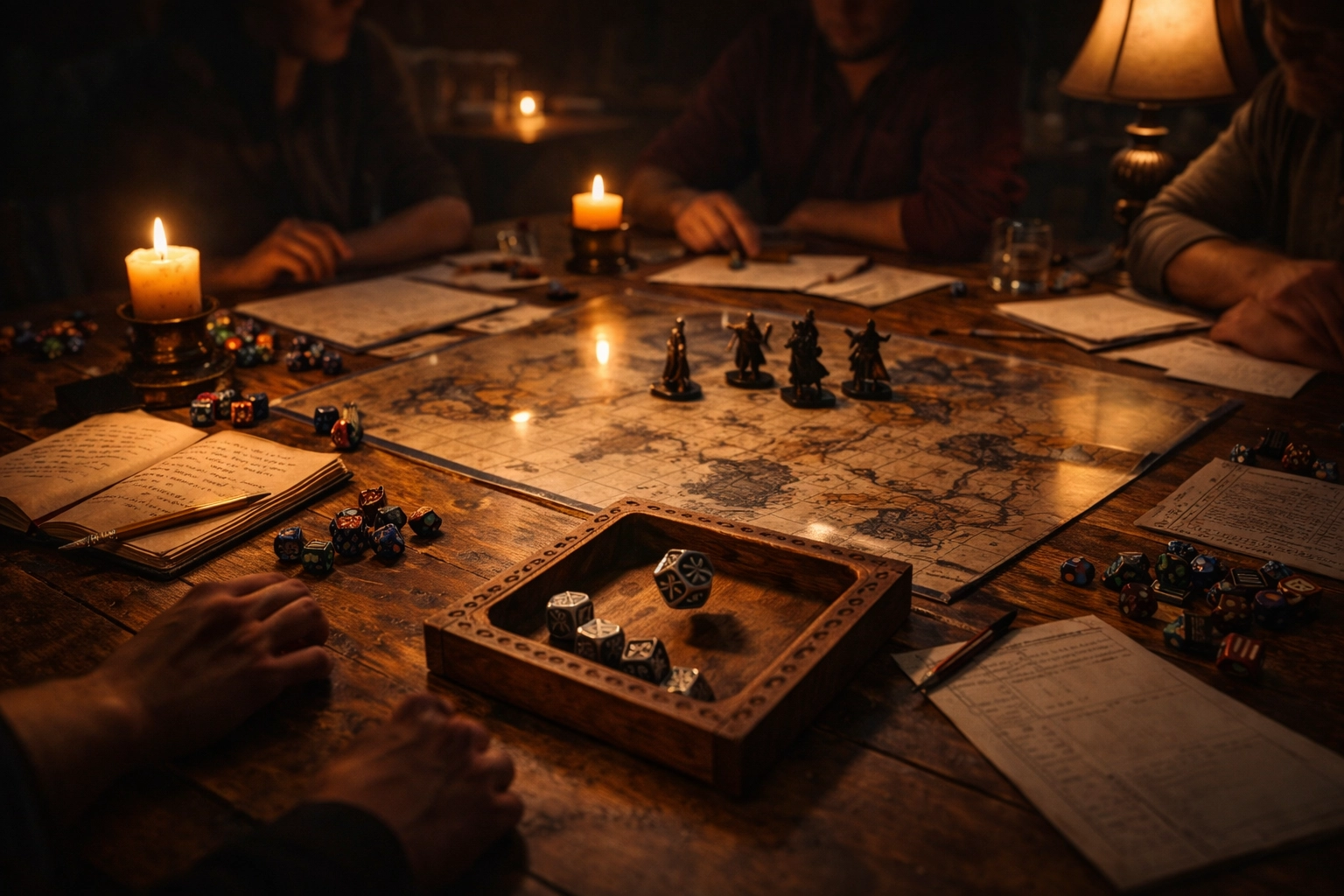
At my table, the shift is rarely dramatic. No theatrical blackout. No spotlight suddenly snapping on. Usually it’s something simple, a lamp dimmed slightly, an overhead light turned off, the room settling into warmer pools of light instead of bright uniform glare.
And almost immediately, players lean forward.
“Nothing mechanical has changed.
But the world has.”
Voices soften. Dice roll more carefully. Conversations narrow from the wide chatter of friends into the focused attention of adventurers standing on the edge of danger.
Nothing mechanical has changed, but the world has.
Light has a strange power at the table. It is invisible until it isn’t. When it’s wrong, the spell breaks instantly. When it’s right, players may not consciously notice it at all, they simply feel the story more clearly.
In the language of ritual, light is liturgy; it shapes the room long before the narrative arrives.
The Room Before the Story
Most tables begin under bright, even lighting. It makes sense. Character sheets need to be readable. Maps need to be visible. Dice need to be seen clearly when they land.
But bright, uniform lighting also signals something else to the brain: social space.
It tells us we are in a room meant for conversation, laughter, and casual interaction. The same lighting used for board games, homework, or a kitchen table gathering.
And that works perfectly, at first. The early moments of a session are social by design. Players arrive, catch up, recount the previous session’s chaos, and settle into their chairs. The energy is loose and welcoming.
But once the story begins, the room must shift. Not abruptly, not theatrically. Just enough that the brain notices something has changed.
Lowering the light slightly narrows the environment. It reduces visual noise. It draws attention toward the table, toward the map, toward the Dungeon Master’s voice.
The room stops being a gathering space and becomes a stage.
“Bright light creates a gathering space.
Dim light creates a story.”
The Subtle Power of Shadow
The most powerful lighting changes are rarely dramatic. They are subtle adjustments that reshape how the room feels without disrupting the practical needs of play.
Bright overhead lighting floods every surface equally. Shadows disappear. The environment feels open and casual. But when overhead lighting softens and illumination comes from smaller sources, lamps, candles, or localized lighting, shadows return. Edges soften; the room feels deeper; players stop looking across the room and start looking inward toward the table.
“A dungeon crawl under fluorescent light feels like a board game. The same scene under softer light begins to feel like a place.”
This matters more than it might seem.
Roleplaying games rely heavily on imagination, but imagination thrives best when the real environment supports it. A dungeon crawl under bright fluorescent lighting feels like a board game. The same scene played under warmer, narrower light begins to feel enclosed.
And when the story calls for tension, a hidden chamber beneath Waterdeep, a whispered conversation in a haunted tavern, shadow does quiet work that narration alone cannot achieve.
Lighting and Emotional Tone
Light doesn’t just shape focus, it shapes emotion.
Warm light, the soft amber glow of lamps or candles, communicates safety, hospitality, familiarity. It feels like a tavern hearth, a quiet evening in Trollskull Manor, or the comfortable warmth of a festival night in Waterdeep.
Cooler light tells a different story. It suggests arcane spaces, sterile chambers, underground halls lit by strange magic. The emotional tone shifts without a single word spoken.
Even slight variations in color temperature can influence how a scene feels.
A warmer room invites conversation. A cooler room sharpens tension.
“The story unfolds inside the light.”
Most Dungeon Masters already understand how music influences emotional tone. Lighting works the same way, but more subtly. It surrounds the table continuously, shaping the environment before the players consciously register it.
The story unfolds inside the light.
Escalation Without Announcement
One of the most useful qualities of lighting is that it can change gradually. Unlike narration, which often requires clear transitions, lighting can evolve slowly across the course of a session.
The beginning of a night might feel open and social. Players arrive, drinks are poured, conversation flows under brighter light. As the story deepens, the lighting narrows slightly. Overhead light softens. A warmer lamp takes prominence. The room grows quieter.
By the time the party descends into danger, perhaps the dark corners of a hidden cellar or the eerie quiet of Trollskull Manor late at night, the room has already changed with them.
No one announces the shift, but everyone feels it. Light becomes a storytelling tool that operates beneath the surface of the narrative. It prepares the room for tension before the players know tension is coming.
“The best lighting changes aren’t dramatic, they’re gradual; and by the time the danger arrives, the room is already ready for it.”
Practical Reality at the Table
Of course, immersion must coexist with practicality. Players still need to read character sheets. Maps must remain visible. Miniatures must be distinguishable from one another. Dice must be easy to read when they land.
At my table, physical maps often sit beneath a sheet of plexiglass wrapped in dry-erase film so players can draw directly onto the surface without damaging the map itself. Combat initiative lives on a whiteboard nearby, visible to everyone in the room. Lighting must support these tools rather than interfere with them.
That means balance. Too little light and the game slows to a crawl as players struggle to read their sheets; too much light and the room loses the atmospheric focus that helps the story take hold.
The goal isn’t theatrical darkness, it’s controlled attention. The table remains illuminated; the rest of the room recedes slightly into the background.
When Lighting Works, and When It Doesn’t
The truth is simple: most players will never comment on the lighting.
They won’t say, “The mood lighting really improved my immersion tonight.”
What they will do is lean forward more often. They’ll pause longer before speaking. They’ll listen more closely. When lighting works, it disappears. It becomes part of the environment, shaping attention quietly.
When it doesn’t work, the problem becomes obvious immediately.
Harsh overhead lighting during a tense horror moment can flatten the atmosphere entirely. Players glance around the room, their focus drifting outward instead of inward. The environment reminds them they’re sitting in a brightly lit room rather than creeping through the unknown.
The story struggles to compete with the real world. Good lighting tips the balance back toward the story.
“When lighting works, players rarely notice it; they simply lean forward.”
Ritual in the Light
Ritual does not require elaborate tools. Often, it begins with something as simple as turning off one light and leaving another on. Over time, those small choices become signals.
Players arrive. The lights settle into their familiar pattern. Dice appear. Character sheets open. Without anyone saying a word, the room becomes the table again. Light has prepared the space.
And when the story begins, the players are already there waiting for it.