DM Diary • Chaos at the Cafeteria Table
Chaos at the Cafeteria Table
An Origin Story
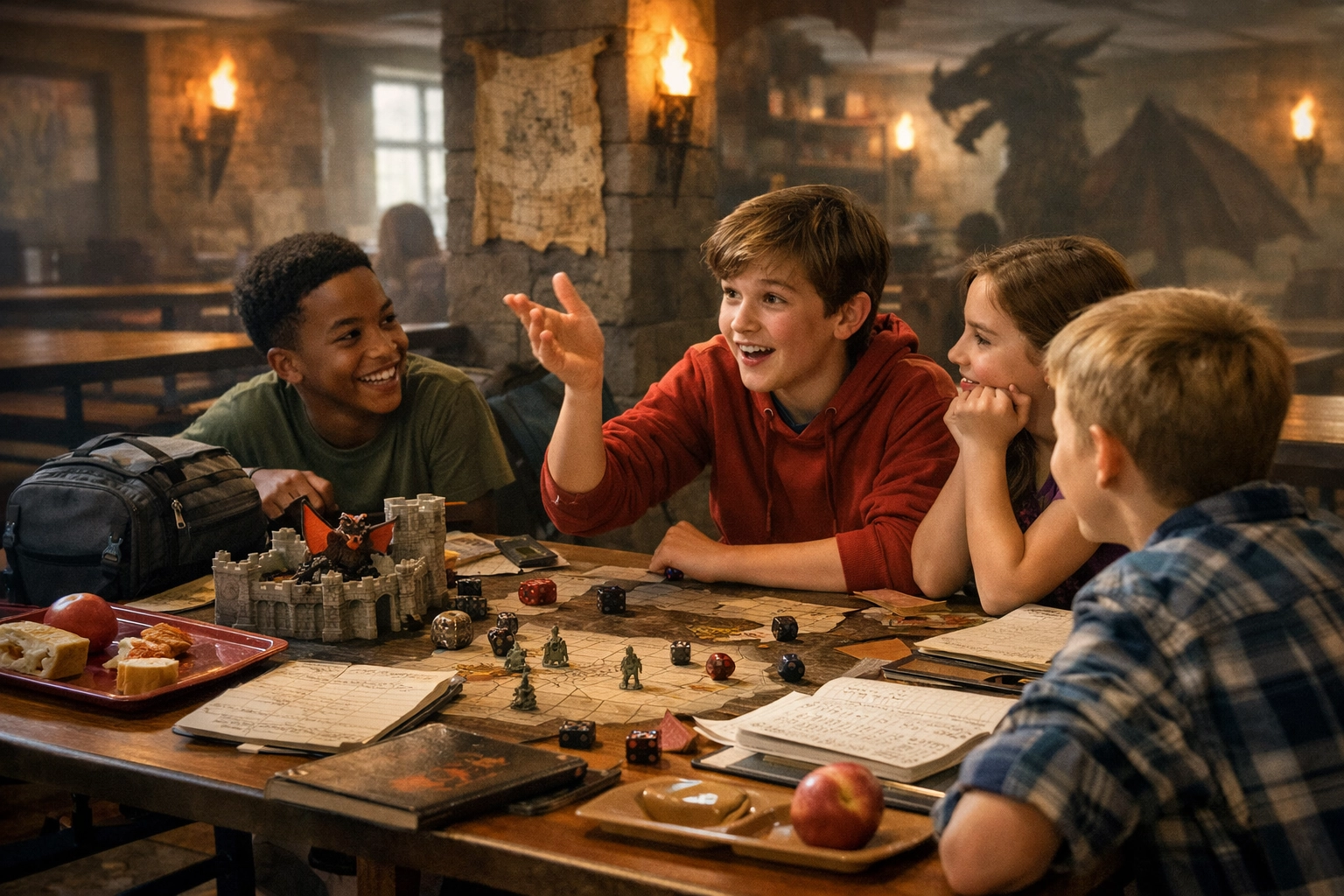
Some D&D games unfold over long evenings, careful prep, and sprawling battle maps.
This one happens at a cafeteria table, during lunch, with a hard stop when the bell rings.
Chaos at the Cafeteria Table is an occasional series about a middle-school D&D group playing in the narrow space between classes, quick sessions, improvised rulings, forgotten dice, and all the raw enthusiasm that comes with first characters and first adventures. They’re currently delving into Heroes of the Borderlands (read my review of the starter set here) and the Caves of Chaos, but the real story isn’t the dungeon. It’s how the game bends, adapts, and survives under real constraints.
These aren’t lessons or best practices, just snapshots of play as it actually happens when time is short; attention is divided, and imagination does the heavy lifting.
“Dad, I Think I Started a D&D Club”
I picked my son up from school one Friday, and before we’d even cleared the parking lot, he said, “Dad, I think I started a D&D club today.”
That sentence alone was enough to make me lean in a little. “Tell me more.”
“Dad, I think I started a D&D club today.”
It turned out it wasn’t much of a plan; just a lunch conversation that took a hard left turn. They’d all recently watched the final season of Stranger Things (read my review of the starter set here) and couldn’t stop talking about it. Eddie Munson. The Hellfire Club. Dice, demons, and the sense that D&D was somehow dangerous and amazing at the same time.
During that conversation, one of his friends mentioned they’d actually played before.
So, my son did what kids do when something suddenly feels possible. He asked if anyone else wanted to play.
Five of them said yes.
“We’re going to play at lunch,” he added, like that part was obvious.
Then, after a pause: “I think I just got volunteered to be the DM too.”
Dice, demons, and the sense that D&D was somehow dangerous and amazing at the same time.
I asked him how he felt about that.
He was excited. And nervous. Mostly nervous. He was worried he was going to be bad at it.
I told him not to worry. He was going to be bad at it. So were the others. It was fine. Nobody was going to care. As long as they had fun, everything else would work itself out. (If you’re thinking about making the transition to DM, check out my series So, You Want to DM for thoughts and insight into the role)
That’s when the rest of the details came out.
“Paper character sheets. Dice nobody owned. And forty minutes to get food, eat, and play D&D.”
They were planning to play during lunch. In the cafeteria. No phones allowed (school rules). Paper character sheets. Dice, which nobody but my son actually owned. And about forty minutes total to get food, eat, and play D&D before the bell sent them back to class.
Over the weekend, we debated on what adventure to run and settled on Dragons of Stormwreck Isle. I printed a map, handed him the paperback module and the Basic Rules from the set, added a handful of extra dice, and sent him back to school on Monday to see what would happen.
First Dice, First Pivot
“So, we played the boat scene out and they scared the merrow away.”
Monday came, and at pickup he climbed into the car and said, very matter-of-factly, “So, we played the boat scene out and they scared the merrow away.”
It took me a second to catch up.
He’d decided to start the party aboard a ship, using the journey to the island as a way to handle introductions. During lunch, a merrow had leapt aboard and demanded a toll for safe passage. They talked. They argued. Dice were rolled. Somehow, the party convinced it to leave without a fight.
Then he added, almost as an aside, “Oh — one of the players has already played Stormwreck Isle. And another kid was absent, so we didn’t introduce them yet.”
That’s when the cracks started to show.
I suggested he might want to trash the cloister and use that change to switch to a different adventure. He thought about it, but decided he wanted to continue Stormwreck Isle. I said OK and left it there.
The next day, he had an update.
He’d trashed the cloister.
“It wasn’t the plan; but it was the right call.”
The party arrived to find it had been ransacked. He introduced the absent player’s character unconscious in the rubble, had them give the party a lead to follow. The bell rang.
The original throughline was effectively severed. Rather than forcing the group onto a path that no longer fit, he made a clean pivot. That night, we swapped out Stormwreck Isle for Heroes of the Borderlands, and the group headed into the Caves of Chaos instead.
It wasn’t the plan; but it was the right call.
That’s a DM instinct you can’t really teach.
He took a disappointing situation, a player who already knew the adventure, a missing character, a story that no longer quite fit, and turned it into something better. A new beginning. A messier dungeon. A place where nobody knew what was coming next.
That’s a DM instinct you can’t really teach.
I have a feeling he’s going to be very good at this. Probably sooner, rather than later.
To Be Continued …
When the bell rings, the dungeon doesn’t resolve neatly. Combat pauses mid-round, plans are forgotten, and characters are left standing exactly where they were. Next time, the game simply resumes, sometimes with better ideas, sometimes with worse ones.
That’s part of the charm.
Chaos at the Cafeteria Table isn’t about playing D&D the right way. It’s about playing it where you can, with who you have, and letting the game grow alongside the people at the table, even if that table happens to be in a cafeteria.