DM Corner • Homebrew • Creature Feature
Creature Feature: Cragmaw Castle
Subtitle
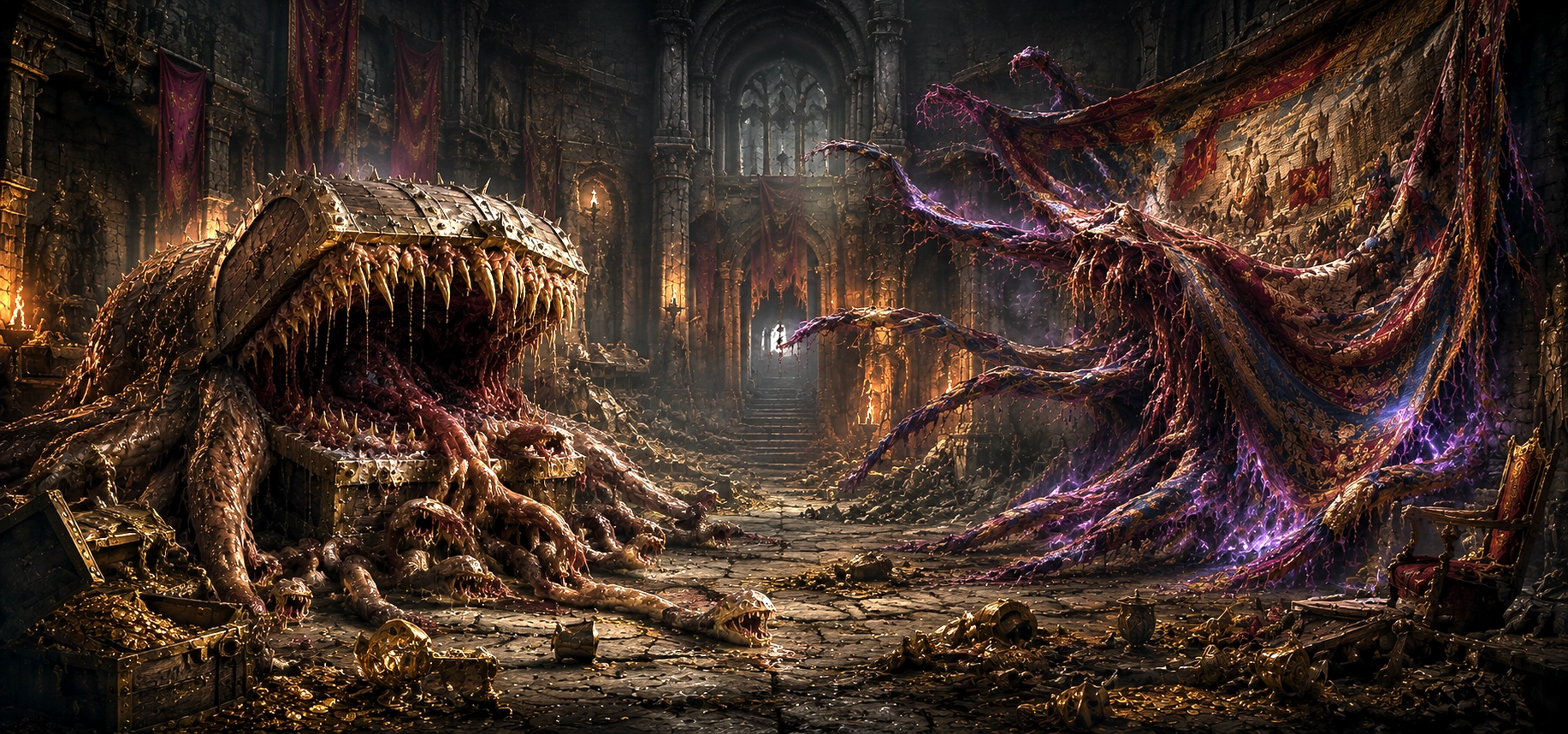
When most players hear “mimic,” they immediately start poking treasure chests with ten-foot poles.
That’s fair.
Years of D&D have taught adventurers that suspicious furniture is dangerous. The problem is that experienced players eventually learn the trick and they stop being surprised by mimics.
As a Dungeon Master, I wanted something that would bring that feeling back. During the Cragmaw Castle arc of my Voxels & Valor campaign, I decided to revisit two classic monsters, the Mimic and the Rug of Smothering, and ask a simple question: What happens if these creatures evolve?
The answer became the Mimic Broodmother and the Tapestry of Terror.
The Mimic Broodmother
Most mimics are ambush predators. They wait, they strike, they attempt to consume a victim before moving on. The Mimic Broodmother takes that concept a step further.
Rather than serving as a single encounter, the Broodmother becomes an encounter engine. It grapples prey, floods the battlefield with acid and pressure, and, most importantly, spawns additional threats as the fight progresses.
What begins as a mimic encounter quickly becomes a resource-management problem.
Do the players focus on escaping the grapple? Do they deal with the growing swarm problem, or do they try to rescue trapped allies?
Every round creates new decisions. That’s exactly the kind of tactical pressure I love introducing at the table.
The Tapestry of Terror
The Rug of Smothering has always been one of my favorite low-level surprises. The Tapestry of Terror takes that core idea and transforms it into something more sinister.
Rather than simply suffocating a target, the Tapestry functions as a battlefield controller. Its enchanted threads restrain, blind, isolate, and suppress spellcasters while forcing the party to make difficult rescue decisions.
The most dangerous part isn’t the damage. It’s the fact that trapped characters stop contributing to the fight.
One restrained wizard or blinded healer can dramatically alter the course of an encounter. Players quickly discover that the real threat isn’t losing hit points; it’s losing actions.
Why They Work Together
The most satisfying encounters aren’t necessarily the deadliest; they’re the ones that force meaningful decisions.
The Mimic Broodmother and Tapestry of Terror were designed to complement one another. The Broodmother encourages players to cluster together to rescue grappled allies. The Tapestry punishes players for clustering.
The Tapestry encourages players to spread out. The Broodmother punishes players who become isolated. Together, they create a tactical puzzle where every solution introduces a new problem.
Those are the encounters players remember.
Bringing Them to Your Table
Both creatures are designed to be easy to drop into existing campaigns.
You’ll find complete stat blocks, tactical guidance, encounter advice, scaling recommendations, and variant hooks designed to help you run them confidently whether you’re using them in a ruined castle, a forgotten manor, or a treasure vault that should have remained sealed.
If you’re looking for monsters that do more than simply trade hit points with the party, these creatures may be exactly what your next dungeon needs.
Because sometimes the treasure isn’t the monster. Sometimes the room is.
Available Now
Part of the growing Creature Feature collection from Tales & Tankards, designed to provide drop-in creatures with clear tactical identities, encounter guidance, and memorable table presence.