DM Corner • Homebrew • Creature Feature
Minecraft Bestiary: Hostile Mobs
Blocky Logic, Deadly Consequences
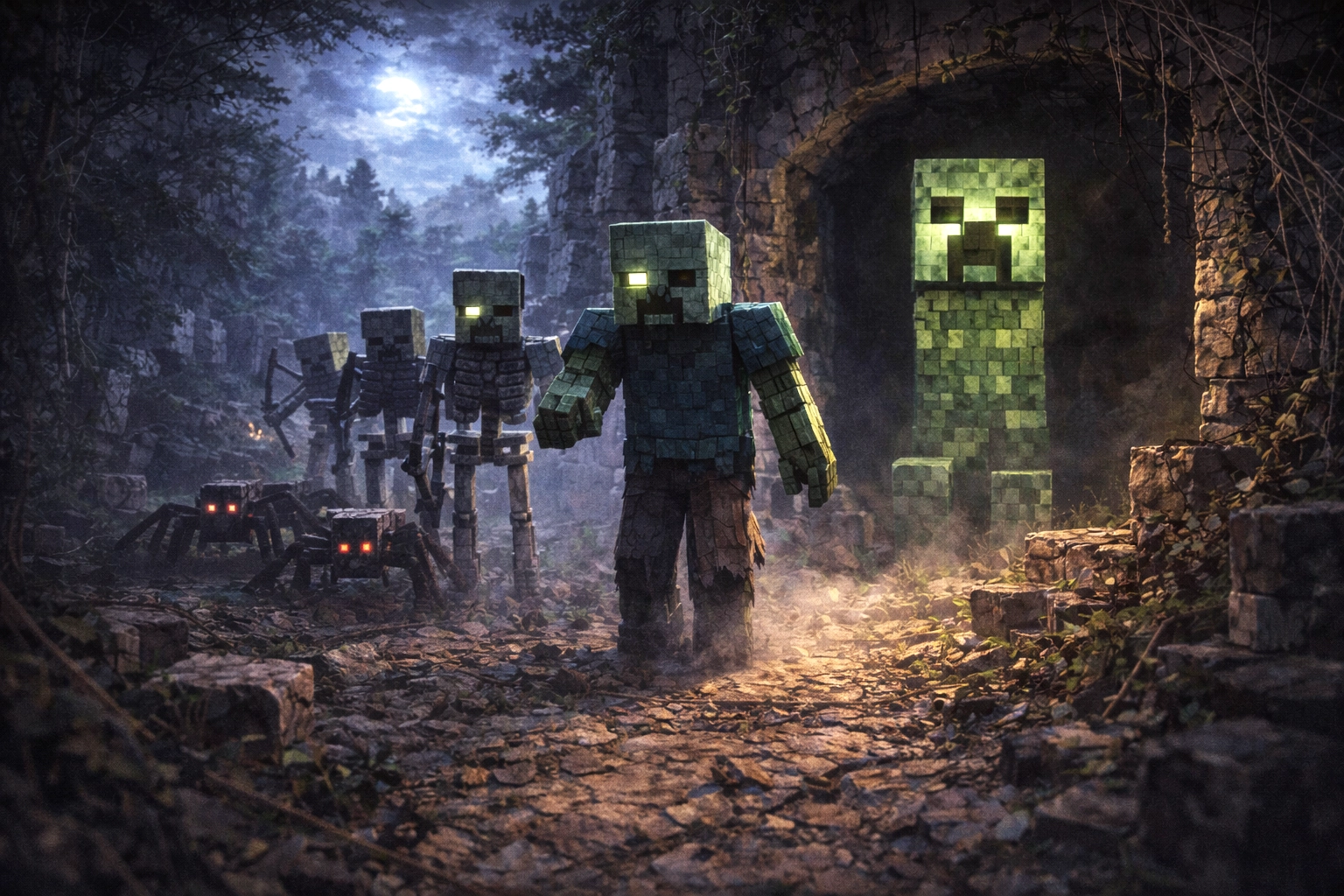
Minecraft’s creatures are deceptively simple. They move in straight lines. They repeat patterns. They look harmless, until they don’t.
This Creature Feature translates the hostile mob ecosystem into a table-ready fantasy bestiary for DMs who want encounters that feel predictable, readable, and suddenly lethal.
These creatures aren’t meant to be clever. They’re meant to be relentless.
Design Philosophy: Simple Rules, Emergent Danger
Minecraft works because its enemies follow clear logic: they appear under certain conditions, behave consistently, and punish complacency more than ignorance.
The Hostile Mob Ecosystem
Each entry below is framed by combat role, so you can build encounters like a toolkit instead of a script.
Goblin
Role: Baseline Threat / Pack Fighter
The goblin is your default hostile. Weak alone, dangerous in numbers. They establish pressure, block movement, and force resource use.
Stat Block: Goblin
Goblin Boss
Role: Escalation / Local Authority
This is what happens when goblins survive long enough to organize. The boss doesn’t fight smarter, he fights louder, harder, and with backup.
Bosses don’t create new rules. They weaponize the rules already on the table.
Stat Block: Goblin Boss
Pillager
Role: Ranged Control / Organized Hostile
Pillagers introduce intent. They hold ground, coordinate fire, and punish reckless movement. Where goblins swarm, pillagers dominate space.
Encounter Tip: Put pillagers on a balcony, ridge, or behind partial cover. Their job is to make the party choose between “advance into danger” or “bleed slowly.”
Stat Block: Pillager
Skeleton
Role: Persistent Ranged Pressure
Skeletons exist to make players move. Left alone, they chip away hit points relentlessly. Paired with terrain, they become lethal.
Skeletons don’t win fights. They make sure you lose them slowly.
Stat Block: Skeleton
Zombie
Role: Attrition / Frontline Undead
Zombies don’t threaten tactics, they threaten time. They soak damage, block paths, and keep pressure on while other creatures do the real harm.
Stat Block: Zombie
Creeper
Role: Burst Damage / Psychological Weapon
Creepers punish poor positioning and complacency with sudden, violent consequences. Their power is as much emotional as mechanical.
Creepers don’t ask “can we win?” They ask “where are you standing?”
Encounter Tip: Use creepers as timers. The party has one round to solve a positioning problem, then the environment changes permanently.
Stat Block: Creeper
Slime
Role: Scaling Threat / Battlefield Disruption
Slimes turn victory into chaos. Killing one often makes the situation worse. They drain actions, block movement, and punish tunnel vision.
Stat Block: Slime
Bugbear
Role: Heavy Bruiser / Shock Trooper
The bugbear represents a spike in raw danger. It hits harder, moves faster, and exists to remind players that not all threats are equal.
Stat Block: Bugbear
Spider
Role: Terrain Control / Ambush Predator
Spiders complete the ecosystem. They climb, flank, and strike from angles players feel safe ignoring. Used well, they turn vertical space into a weapon.
The moment the party stops looking up is the moment the spider fight begins.
Stat Block: Spider
Running Minecraft-Style Encounters at the Table
To capture the Minecraft feel, keep the rules simple and let the situation do the work.
- Encounters escalate naturally, not narratively.
- Multiple simple enemies beat one complex enemy.
- Terrain matters more than abilities.
- Darkness and confined spaces are the real villains.
Think less “boss fight,” more: “We should have left earlier.”
DM Callout: The Minecraft Loop
Start with nuisance pressure (goblins/zombies). Add ranged tax (skeletons/pillagers). Insert one high-impact event (creeper/slime split). Then complicate the geometry (spider). Players will feel the “oh no” moment land naturally.
Why This Bestiary Works
This ecosystem supports early-to-mid-tier play, encourages adaptation, punishes overconfidence, and rewards preparation and positioning. Most importantly, it feels familiar, even when players can’t quite explain why.
They know these monsters. They’ve survived them before.
Just… not like this.
Creature Feature Series
This Minecraft ecosystem is designed as a tight, self-contained bestiary, perfect as a one-off feature, a themed side-realm, or a contrast piece to more traditional fantasy ecologies.
Explore the Creature Feature Series
This Minecraft package is part of the ongoing Creature Feature series. A growing collection of redesigned, table-ready creatures built around role clarity, encounter composition, and real play needs.
You can find the full index, along with all published and upcoming creatures, on the Creature Feature Index Page.