Homebrew • DM Tips • Ritual at the Table
Ritual at the Table: The Scent of Story
Memory, Association, and the Most Invisible Ritual
There is a moment at my table that happens almost every session now, though I didn’t plan it.
Maple reaches into his dice bag and pauses. Not to choose a die, but to choose a scent.
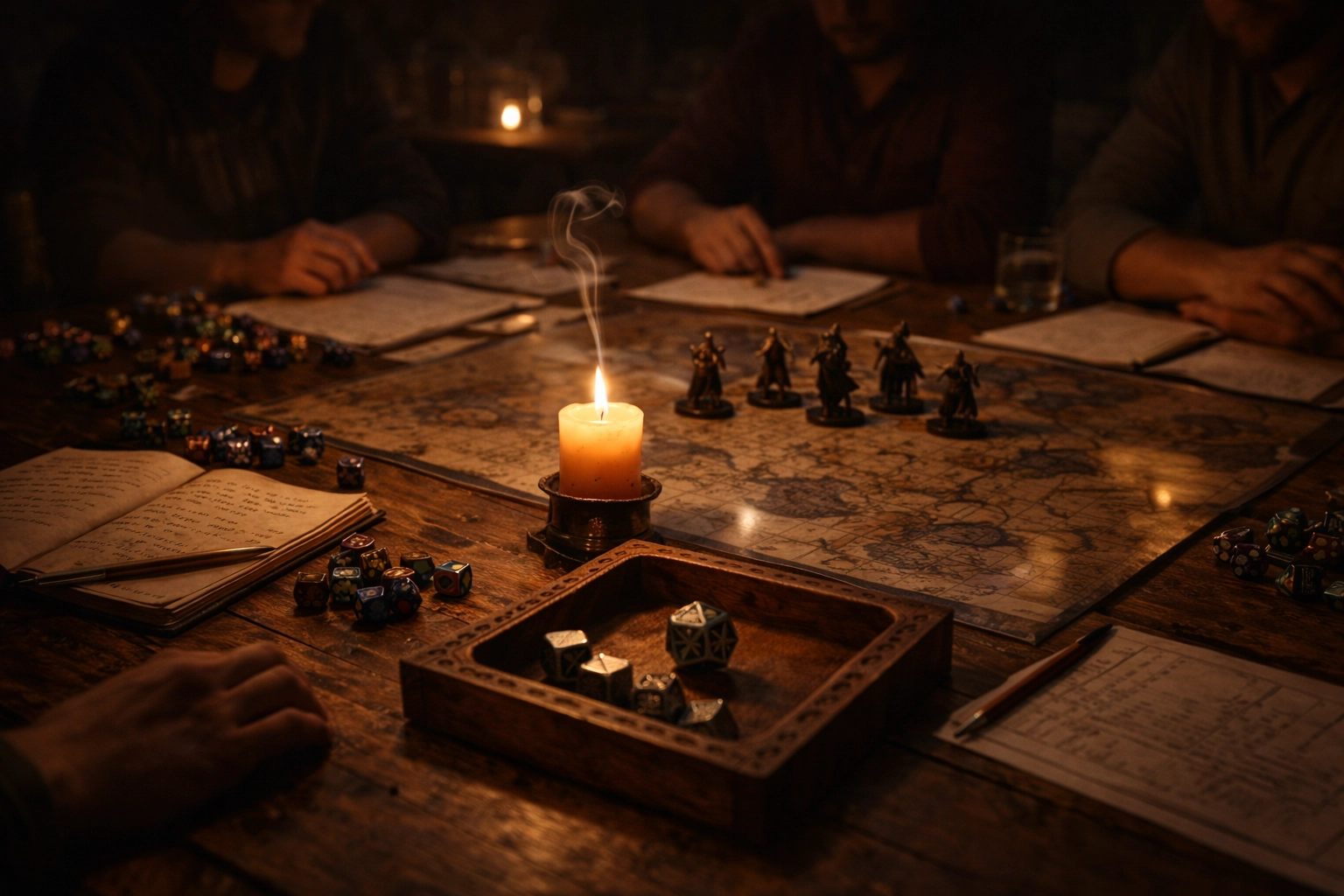
The bag he brings to the table holds several sets of Baron Smelly Bones’ Scented Dice or “smelly dice,” as they’ve taken to calling them. Each set carries a faint fragrance, subtle, but unmistakable once the dice are in motion. Maple doesn’t just grab whichever one is closest. He considers the moment.
If the table feels tense, he might reach for one scent; if the scene is lighter, another. If something dramatic is unfolding, he sometimes pauses longer, as if weighing the moment before the roll.
Then the dice hit the tray. The scent travels across the table in a quiet wave.
No one comments on it anymore. It’s just part of the rhythm now, another small signal that something important is about to happen.
And one night, somewhere between the roll and the laughter that followed it, I realized something. I realized that I had been thinking about ritual at the table all wrong.
Because scent had already arrived.
“Maple doesn’t just choose dice for the roll. He chooses the scent.”
When Ritual Comes from the Table
Dungeon Masters spend a lot of time thinking about atmosphere.
We adjust lighting, we cue music, we lower our voices when the tension rises.
Those things are deliberate. We plan them. But ritual doesn’t always begin with the DM. Sometimes it emerges from the players.
“Ritual doesn’t always begin with the Dungeon Master. Sometimes it emerges from the players.”
Maple’s scented dice started as a novelty, a small curiosity brought to the table because they were interesting, unusual, maybe even a little funny. At first the table reacted to them the way players react to any new prop: curiosity, a few jokes, maybe a quick sniff passed around the table.
But the novelty faded; the scent remained. Over time it became something quieter. More integrated into the flow of the session. The dice rolled, the scent drifted across the table and play continued.
Until I started noticing something else. Those scents lingered. Not just in the room, in memory.
Why Scent Works Differently
Of all the sensory tools we use at the table, light, sound, texture, scent is the most unusual. It is also the most powerful.
Unlike sight or sound, scent bypasses the brain’s usual filters and goes straight to the regions associated with memory and emotion. That’s why a smell from childhood can return you to a specific moment instantly. A kitchen, a holiday, a particular season of your life.
The connection between scent and memory is immediate. And that realization raises an interesting possibility for tabletop play.
If sound sets emotional tone; if lighting directs attention, if texture gives the world physical weight…
Then scent may be the ritual that anchors memory. Not the moment. The campaign.
“If sound sets emotional tone, and light directs attention, then scent may be the ritual that anchors memory.”
The Ritual We Haven’t Been Using
For some time now I’ve been thinking about immersion primarily in terms of sound and light. Music cues emotional shifts; lighting helps focus the table.
Those tools work well. They are effective and immediately noticeable.
Scent is different. Scent works slowly, quietly.
It’s not something players actively pay attention to. In fact, when it’s used well, they probably shouldn’t notice it at all. It becomes background texture, another small signal that the world has begun. Which makes it incredibly interesting as a ritual element.
Imagine lighting the same candle before every session of a campaign. Not a different one each week. The same scent, consistently, over months of play. Eventually the brain begins to associate that scent with the campaign itself.
Light the candle, the world returns. Not because the Dungeon Master announces it, because the brain remembers.
Learning from the Players
What Maple unintentionally demonstrated with his scented dice is something worth paying attention to: Ritual doesn’t always originate with the Dungeon Master.
Sometimes it emerges organically from the table culture itself.
Players develop habits. They bring objects that become part of the shared experience. A particular dice set that only comes out during boss fights, a lucky miniature, a notebook filled with years of campaign notes.
Those things become artifacts of play.
Maple’s scented dice have become one of those artifacts.
The scent that accompanies a roll now feels like part of the moment, a subtle sensory cue that the stakes have risen, that something important is happening, that the world is holding its breath while the die settles.
It wasn’t designed that way, but it showed me what scent might be capable of if it were.
The Discipline of Subtlety
If scent is going to become part of ritual at the table, it comes with one very important rule: Subtlety.
Scent should whisper, not shout. Overpowering fragrances can quickly become distracting, uncomfortable, or even unpleasant for players. People experience scent differently, and what feels atmospheric to one person might feel overwhelming to another.
“Scent should whisper, not shout.”
There are also practical considerations. Ventilation matters, allergies matter, consent matters. If scent becomes part of a table’s ritual, it needs to be introduced thoughtfully and gently. A faint presence that enhances the environment without dominating it.
Done well, scent becomes something players only notice when it’s gone. And that’s exactly where its power lies.
Can Scent Exist at the Digital Table?
One of the interesting challenges of ritual is how it translates beyond a physical table. My Dragon Heist campaign plays in person, around a shared table. Voxels & Valor, on the other hand, unfolds across Discord, voices and screens connecting players who are not physically present with one another.
At first glance, scent seems impossible in that environment. But ritual has a way of adapting.
What if players agreed to light the same candle at home before the session begins? What if the Dungeon Master shared the scent recommendation alongside the session notes?
What if the ritual began with a shared moment across distance?
“Light the candle.”
“Alright. Ready.”
The world begins.
It’s an experiment worth considering.
Because if ritual is about shared transition, scent may still have a place, even when the table itself disappears.
“Texture gives the roll its weight. Light shapes the room. Sound frames the moment. But scent may be the thread that binds sessions together.”
The Next Experiment
Until Maple brought those scented dice to the table, scent wasn’t something I had considered part of tabletop ritual. Now it feels like a missing piece.
Texture gives the roll its weight. Light shapes the room. Sound frames the moment.
But scent may be the quiet thread that binds sessions together, the subtle signal that tells the mind we have returned to a familiar place: a campaign, a tavern, a world waiting patiently for us to come back.
The next time we gather at the table, I may try something new. Not music, not lighting.
Just a small candle, lit quietly before the first die is rolled, and we’ll see what happens when the world begins to smell like story.