Voxels & Valor • Session 7 Recap • The Aetherian Adventure
Even the Furniture Is Lying
Played: July 28, 2024
Rendered Wrong in the Hills
Gnomengarde didn’t greet the party with answers, only mist, denial, and a barrel that learned how to bite.
By now, the party had learned a simple truth about Aetheria:
If something looked peaceful, it probably wasn’t.
The Misty Pool
Gnomengarde did not announce itself with walls or gates.
It hid.
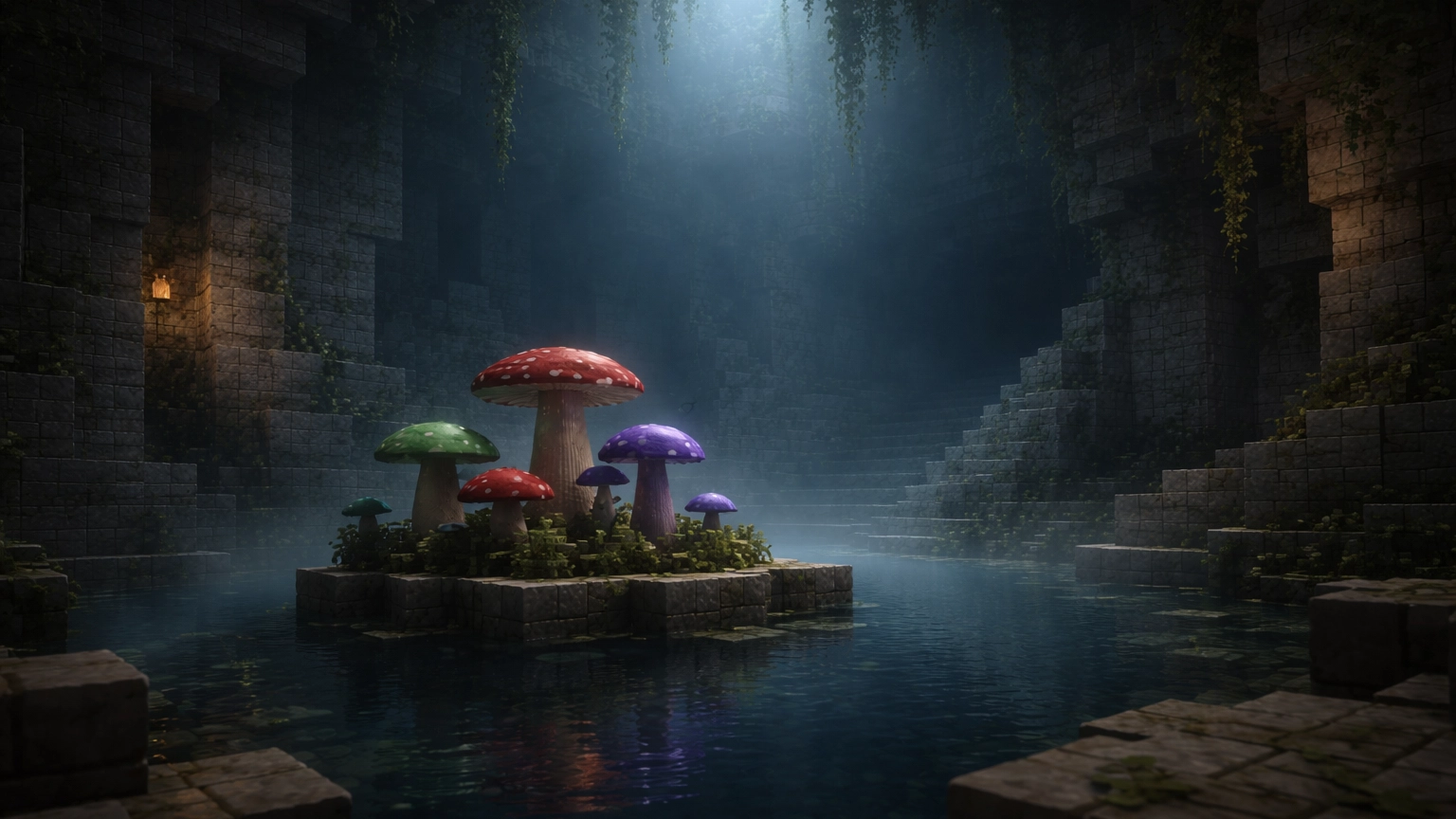
The party emerged into a cavern dominated by a still, mist-choked pool. The air was thick with drifting fog, rolling in slow, blocky curls as though the world itself were struggling to finish rendering the space. Visibility collapsed just a few steps from shore. Sound behaved strangely here; footsteps echoed once too often, then cut off entirely.
It was difficult to tell where the cavern ended.
They moved carefully, shapes resolving only when they were nearly upon them. Stone rose from the water in abrupt, squared edges, the pool’s surface unnaturally smooth, reflecting light in flat planes instead of ripples. It felt less like water and more like a texture stretched too thin.
Note: In Aetheria, the uncanny isn’t always a monster. Sometimes it’s the way the world behaves—like it’s been built, not grown.
At the center of the pool sat an island, a low platform of stone blocks ringed with enormous mushrooms. Each was a different color: red, green, purple. Their caps were too perfect, too symmetrical, as if chosen from a palette rather than grown.
The party lingered longer than they meant to.
They debated the mushrooms in low voices. Were they magical? Poisonous? Decorative? The kind of thing you regret not picking up later? In the end, curiosity won out. One of each was harvested and tucked carefully into the Bag of Holding, a small hedge against future uncertainty.
Only then did they notice the sloped passage on the northeastern edge of the pool. The stone rose in shallow, uniform steps, worn smooth by countless small feet. As they climbed, the mist thinned behind them, retreating until, without ceremony, it simply stopped.
The pool vanished from sight. And it did not feel like something they could easily return to.
Through Gnomengarde
The halls beyond felt occupied, but not busy.
Gnomish tunnels cut through the stone with clean angles and deliberate turns. Floors stepped up and down in precise, predictable increments. Everything felt measured, designed, and yet subtly wrong. Doors stood ajar without explanation. Tools lay where they had been dropped, but not in haste.
It was the kind of disorder born of avoidance, not panic.
More than once, the party caught movement at the edges of their vision, a shadow slipping around a corner, the faint clack of something being adjusted just out of sight. Sounds carried oddly here. Laughter echoed a moment too long, then stopped mid-note.
No alarms were raised.
No guards appeared.
Which, somehow, made it worse.
They passed through a dining chamber where long tables were set with half-finished meals, mushroom dishes cooling exactly where they had been abandoned. No sign of struggle. No sign of urgency.
Just absence.
Then came warmth. Noise. Motion.
The Kitchen
If Gnomengarde had a heart, this was it.
The kitchen was chaos, but not the violent kind. Everything here was built close to the ground or reachable only through absurd rope-and-pulley mechanisms that clattered and spun with the slightest tug. One lever raised a shelf. Another dropped a ladle. A third did something entirely unrelated and faintly dangerous.
Five rock gnomes worked amid this madness as if nothing were wrong.
They cooked. They kneaded. They pressed oil from mushrooms and fermented wine in squat barrels nearly as tall as they were. None of them paused when the party entered. None reacted the way sane people would to armed strangers appearing in their workspace.
The conversation that followed was baffling.
Questions were answered sideways. Concerns were met with cheer. Any mention of danger, missing gnomes, or Mad King Korboz earned polite smiles and immediate topic changes. The gnomes were friendly, helpful, and utterly unwilling to acknowledge that anything was amiss.
Note: This is “social tension” done right: the room isn’t hostile, but it refuses to be honest.
And yet, something clearly was.
Eventually, the same answer surfaced again and again:
If you want real answers, speak to Fibblestib or Dabbledob in the workshop.
The kitchen gnomes wouldn’t leave their posts. Wouldn’t explain further. But they were eager, almost relieved, to point the way.
The message was clear, even if the words weren’t:
Everyone here knew something was wrong.
No one here would say it out loud.
The Autoloading Crossbow Platform
Following a different route back through the complex, the party traced the source of a sharp mechanical clatter echoing through the stone halls.
The chamber opened into a firing platform dominated by an elaborate contraption of gears, levers, and rotating arms, an autoloading crossbow the size of a small siege engine. Bolts snapped into place with alarming speed, the entire device pivoting and tracking with unsettling precision.
Seated calmly at its center was its inventor.
She didn’t greet them.
She laughed.
Then the machine opened fire.
DM Note: Gnomengarde’s danger isn’t announced, it’s triggered. One moment you’re exploring; the next, you’re a test subject.
What followed was less a battle and more a field test. Bolts slammed into walls. Gears screamed. The device adjusted its aim in sharp, jerking movements while the gnome cackled and shouted fragmented observations.
“Why are you dodging? Stand still, it’s for science!”
“Efficiency parameters optimal. Commencing test protocol.”
“Hypothesis: organic matter reacts negatively to high-velocity projectiles. Verifying.”
It became clear quickly that she wasn’t malicious, just utterly consumed by her work. When the contraption finally sputtered and jammed, the violence bled out of the room, leaving ringing ears, splintered stone, and a party badly in need of rest.
The gnome blinked at them, frowning.
“Oh,” she said. “You weren’t supposed to dodge.”
She introduced herself as Facktoré.
“Why are you all so angry?” she asked, genuinely confused. “It’s just a game.”
A Rest That Wasn’t
Battered and low on resources, the party retreated to a nearby storeroom.
Crates lined the walls. Barrels sat neatly stacked. Zend sealed the stone doorway with a careful application of Mold Earth, the blocks sliding into place with a soft grind that felt reassuringly final.
They rested.
They slept.
And then something moved.
Sagora woke to a sensation that didn’t belong; cold, wet, and sticky, sliding slowly across her leg. In the dim light, she realized one of the wine barrels had shifted, its weight pressing against her.
When she tried to push it away, the barrel opened its mouth.
The mimic struck fast. Adhesive flesh snapped shut as panic tore through the room. Sagora barely had time to shout before the creature revealed itself fully, the lie collapsing into violence.
The fight was short and vicious. The mimic fell before it could do more than teach a brutal lesson:
In Gnomengarde, even the furniture could lie.
Uneasy Silence
When the mimic finally lay still, the storeroom felt smaller.
Its remains slumped back into the shape of a ruined barrel, its deception no longer convincing now that the truth had been forced out of it. Sticky residue clung to the floor. The smell of sour wine lingered, sharp and unpleasant.
No one spoke at first.
They moved differently after that, slower, more deliberate. Bedrolls were repositioned. Crates nudged, then nudged again. Someone checked the ceiling. Someone else checked it twice.
DM Note: The mimic didn’t just hurt them. It changed how they behaved. That’s when a dungeon becomes a memory.
Zend’s earthen seal still held, the blocks snug and unmoving, but the sense of safety it once offered was gone. The party had learned something they couldn’t unlearn:
Rest did not mean safety here.
Stillness did not mean harmless.
When they settled again, it was with weapons within reach and one eye always half-open. Sleep came in fragments. Every scrape of fabric sounded too loud. Every shift of weight felt suspicious.
Gnomengarde did not attack them in the night.
But it didn’t reassure them, either.
Where the Session Leaves Us
They had come to the hills seeking help against a dragon.
Instead, they found a place quietly unraveling, gnomes pretending nothing was wrong, machines firing on visitors, and monsters hiding in plain sight.
Somewhere deeper in the complex, Fibblestib and Dabbledob waited.
And the party pressed on, knowing now that nothing in Gnomengarde could be taken at face value.
Not even the furniture.