DM Corner • Series • So, You Want to Be a DM
Tools & Resources: What Actually Helps New DMs
The Best Starting Point for New Dungeon Masters
There’s a moment every new Dungeon Master reaches sooner or later.
You sit down to prepare, open your browser, and type something innocent like “DM tools” or “D&D prep help.”
Twenty minutes later, you’re staring at:
- spreadsheets
- apps
- trackers
- generators
- dashboards
- videos titled “The Only Tools You’ll Ever Need”
And somewhere in that pile of advice, a quiet fear creeps in:
Everyone else seems more equipped than I am.
If that thought has crossed your mind, let’s settle it now.
You do not become a Dungeon Master by assembling the perfect toolkit. You become one by running games.
This article isn’t about everything you could use. It’s about what actually helps—and what you can safely ignore until later.
What Tools Are Actually For
Let’s start with a simple reframing.
Tools exist to:
- reduce friction
- offload memory
- save time
- increase comfort
They do not:
- make you creative
- fix anxiety
- replace preparation
- guarantee fun
A tool that adds stress is not a tool—it’s a distraction.
If you’ve been following along with this series, you already know the pattern:
Tools come last—because they’re meant to serve a table that already exists.
The True Essentials (What You Actually Need)
Let’s strip this all the way back.
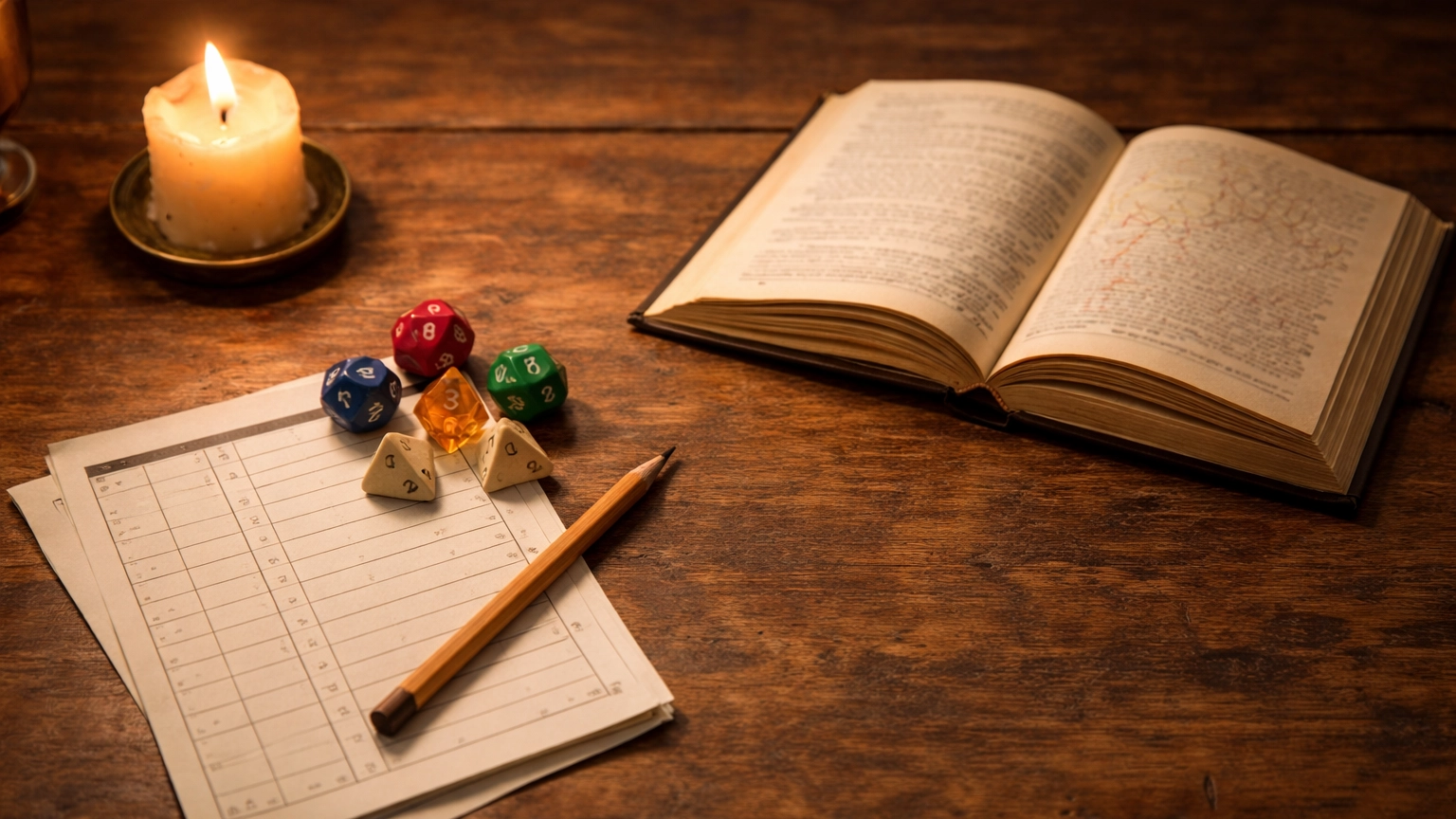
To run your first session, you need:
- Dice (physical or digital)
- Something to write with
- A way to see the rules
- A way to track turns
Some of the best games ever played happened around kitchen tables with mismatched dice and coffee-stained notes.
If your setup feels simple, you’re doing it right.
Helpful Tools—Organized by Purpose, Not Popularity
When tools do help, it’s because they solve a specific problem.
Here are some commonly useful categories—not requirements, just options.
Rules Reference & Character Management
Many new DMs find it helpful to have quick access to rules and character information. Options range from physical books to digital platforms like D&D Beyond, which centralize character sheets, spells, and references in one place.
Digital tools can:
- speed up lookups
- reduce page-flipping
- help newer players track abilities
Physical books, on the other hand:
- encourage slower, more deliberate play
- reduce screen distraction
- feel more tactile at the table
There’s no correct choice here. Use what feels comfortable for your group.
Prep & Organization
Some DMs like structured notes. Others prefer loose bullet points.
Helpful tools here include:
- simple notebooks
- checklists
- encounter builders
- initiative trackers
At-the-Table Support
These are tools that help sessions flow smoothly:
- initiative trackers
- condition reminders
- basic maps or tokens
For in-person tables, physical aids often shine:
- index cards
- folded paper tents
- dry-erase boards
They’re visible, flexible, and don’t pull attention away from the table.
Inspiration & Idea Generation
Random tables. Generators. Reading adventures for ideas.
A Gentle Word About Virtual Tabletops
Virtual Tabletops (VTTs) are powerful tools. Platforms like D&D Beyond, Roll20 and Foundry VTT can:
- automate mechanics
- handle maps and tokens
- support remote play beautifully
They are also:
- complex
- time-intensive to learn
- easy to overconfigure
If you’re playing online, a VTT may be essential. If you’re playing in person, it is absolutely optional.
Learn the game first. Add the layers later—when the benefit is clear.
Tools You Can Safely Ignore (For Now)
Here’s permission you didn’t know you needed.
You can safely ignore:
- massive map libraries
- advanced automation
- custom dashboards
- deeply optimized workflows
- extensive homebrew systems
You are allowed to grow into tools. You do not have to start there.
Build Your Toolkit the Same Way You Build Your Skills
Here’s the simplest, healthiest way to adopt tools:
- Forgetting initiative? Add a tracker.
- Losing track of conditions? Add reminders.
- Prep taking too long? Try a new note format.
This keeps your setup intentional—and your stress low.
A Short Story About Tools
There was a time I thought I needed everything.
Apps. Notes. Systems layered on systems.
Then one night, mid-session, something broke. A tool failed. A screen froze. And the table… kept going.
The players didn’t notice. They were too busy talking, planning, laughing, and arguing in character.
The table was doing the work. Everything else was just furniture.
You’re Already Equipped
If you’ve read this series in order, you’ve already done the hardest work.
- You know why you’re DMing.
- You’ve chosen an adventure that supports you.
- You know how to prep without drowning.
Tools are just comfort items now—not lifelines.
You don’t become a Dungeon Master by collecting gear. You become one by running sessions, making rulings, laughing with your players, and showing up again next week.
You’re ready. Pull up the chair.