DM Corner • DM Tips
What I Use to Manage Remote Sessions
Tools, habits, and tradeoffs from keeping a real table alive at a distance.
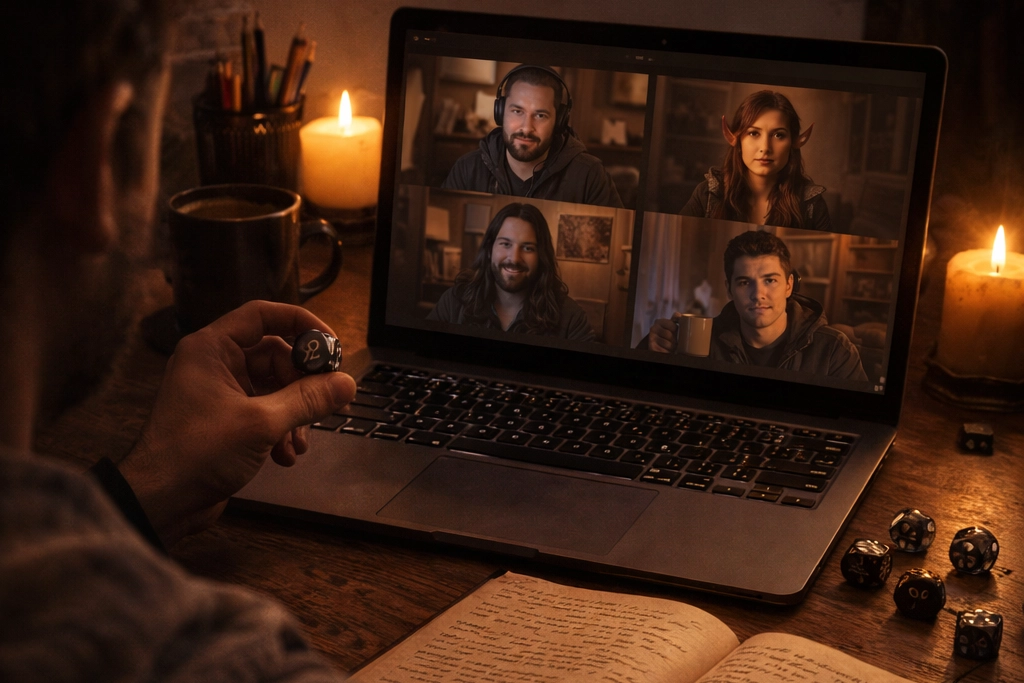
My Voxels & Valor table includes family in another state. Same time zone, different geography. The choice was simple: figure out remote play or stop playing altogether. We chose to adapt.
I’ve now been running long-form remote sessions for about a year and a half, 3–4 hours at a time, originally weekly and now bi-weekly. Long enough to get past novelty, long enough for habits (good and bad) to set in.
This isn’t a “best tools” list. It’s a record of what’s actually worked for me, where the friction still lives, and why I’ve resisted the urge to over-engineer something that already functions.
The Real Problem with Remote Play Isn’t the Tools
Learn from Experience: Remote play doesn’t collapse all at once, it erodes—one small interruption at a time.
Remote sessions don’t fail because the software is bad. They fail because friction compounds when attention is split.
Audio hiccups interrupt intent. Visual delays break momentum. Over-complex setups turn play into troubleshooting.
Every tool choice I’ve made is in service of one goal: protecting clarity and preserving flow.
That’s the lens for everything below.
“Remote play doesn’t collapse all at once. It erodes; one small interruption at a time”
My Philosophy for Remote GM-ing
Before tools, I had to define boundaries.
- Lower onboarding friction beats feature depth
- Momentum matters more than perfection
- If a tool adds stress during play, it’s the wrong tool
- I need to understand player intent before moving forward
That last one matters more than it sounds. Audio issues are still my biggest pain point, and mishearing a player doesn’t just slow things down, it risks misunderstanding intent. That’s where trust breaks.
So, I slow down. I clarify. I ask again if I need to.
Remote GM-ing requires patience, not speed.
The Core Stack (What I Actually Use)
Voice, Video, and Table Presence
We use Discord for audio, video, and chat.
I tried other platforms early on. Zoom’s free tier time limits were a non-starter. Teams was powerful but harder to onboard. Google Meet struggled in a mixed OS environment. Discord, by contrast, just worked.
Persistent channels, rooms, and text chat matter for campaigns, not meetings. Discord understands that.
Audio is still our weakest link. On my end, I’ve upgraded to a dedicated mic and camera. On the other end, five players share a single room and a laptop mic, occasionally supplemented by a streaming mic if someone remembers it.
It’s not perfect. It’s workable.
Audio clarity isn’t a “nice to have.” It’s the difference between understanding intent and guessing at it.
Warning: Audio clarity isn’t a nice-to-have. It’s the difference between understanding intent and guessing at it.
Virtual Tabletop
We use D&D Beyond Maps.
I chose it for one reason: convenience. Everyone already had characters there, and minimizing context switching mattered more than chasing the perfect VTT.
The platform has improved dramatically over time, especially with creature management and initiative. That improvement has helped sustain immersion instead of undermining it.
I’ve looked at Roll20, Foundry VTT and Fantasy Grounds. All three are strong tools. But mid-campaign, the real cost isn’t money, it’s time, attention, and disruption.
“Good enough” is sometimes the correct answer.
DM Tip: “Good enough” is sometimes the correct answer—especially mid-campaign.
Recording Sessions (The Quiet MVP)
I don’t trust my memory. I trust receipts.
Several months into remote play, I started recording sessions using Streamlabs.
That decision changed everything.
Being able to review what was actually said, what choices were made, what assumptions were voiced, made plot continuity easier and reduced second-guessing.
Recording isn’t about content creation. It’s about institutional memory.
I don’t trust my memory. I trust receipts.
TL;DR My Remote Setup
The short version:
I don’t chase perfect tools. I protect clarity, momentum, and trust.
Voice & Video
- Discord: Low onboarding friction, persistent rooms, and reliable mixed-OS support.
Virtual Tabletop
- D&D Beyond Maps: Convenient, improving fast, and “good enough” to avoid mid-campaign disruption.
Recording
- Streamlabs: Session recordings = better continuity, confidence, and recall.
Notes & Prep
- Published material in D&D Beyond
- Flow and themes in Word
- Session notes on paper backed up to the cloud via OneDrive
Dice
- Physical dice for me, player’s choice for them
- Discord functions as my DM screen
Music & Ambience
- None (audio clarity beats atmosphere)
Handouts
- Maps only. For now.
- Physical handouts remain an in-person favorite
Remote play wasn’t a preference for me. It was the price of continuing to play.
Notes, Prep, and Where My Brain Lives
I run published campaigns, so baseline material lives on D&D Beyond. Beyond that:
- Themes and flow notes live in Microsoft Word
- Session notes are scribbled in pencil during play
- Those notes get folded into the next prep document
- Everything ends up in the cloud via OneDrive
My Voxels & Valor notes are intentionally loose, with occasional structured segments when needed. Prep exists to support reaction, not control outcomes.
Remote play breaks fast if the GM can’t access their brain from anywhere.
Dice, Screens, and Trust
I roll physical dice. Always.
Players can choose their own method, but for me, real dice are grounding. I don’t use a DM screen in person anymore, space constraints made that decision for me, but remotely, Discord is my DM screen.
I roll behind it. Always.
“Discord is my DM Screen”
I honestly can’t recall the last time I rolled publicly in a remote session.
That secrecy isn’t about cheating. It’s about preserving uncertainty, pacing, and tone.
Music, Ambience, and What I Let Go
I don’t use music.
Not because I dislike it, I actually enjoy it in theory, but because:
- Audio is already fragile
- Adding another sound source risks clarity
- Curating scene-appropriate music costs prep time I don’t have
If ambient audio were easy, integrated, and low-risk, I’d consider it. Until then, silence is better than distortion.
Handouts (The Thing I Miss)
I love handouts. In person.
Remotely, I haven’t cracked that code yet. I’ve toyed with the idea of mailing physical packets and cueing players when to open them, but that’s still aspirational.
For now, I stick to maps. Visual clarity without extra moving parts.
What Ended Up Matter More Than Expected
Recording sessions.
I didn’t realize how much cognitive load it would lift until I had it. Knowing I can check what actually happened makes forward momentum easier and prep more confident.
Advice for First-Time Remote GMs
DM Advice: If you care about your players, you’ve already won. Everything else can be worked out later.
Care about your players first. They’re the heart of the game.
If you connect with them, you’ve already won.
Just like your first in-person session, embrace the mistakes. Let them work themselves out. Stay in the moment. Go with the flow.
The rest, tools, polish, optimization, can be worked out later.
If you’ve got trust and attention, you’ve already built the table.
The Biggest Misconception About Remote Play
That it can’t be intimate.
It’s different from in-person play, yes, but different doesn’t mean lesser. You can still feel present. You can still feel connected. You can still share moments that linger long after the session ends.
Don’t let anyone tell you otherwise.
Conclusion:
Remote play can still be intimate. Don’t let anyone tell you otherwise.