DM Corner • Creator Spotlight • Lunch Break Heroes
Designing Dread: A Creator Spotlight on Lunch Break Heroes
Part One: Intent Before Impact
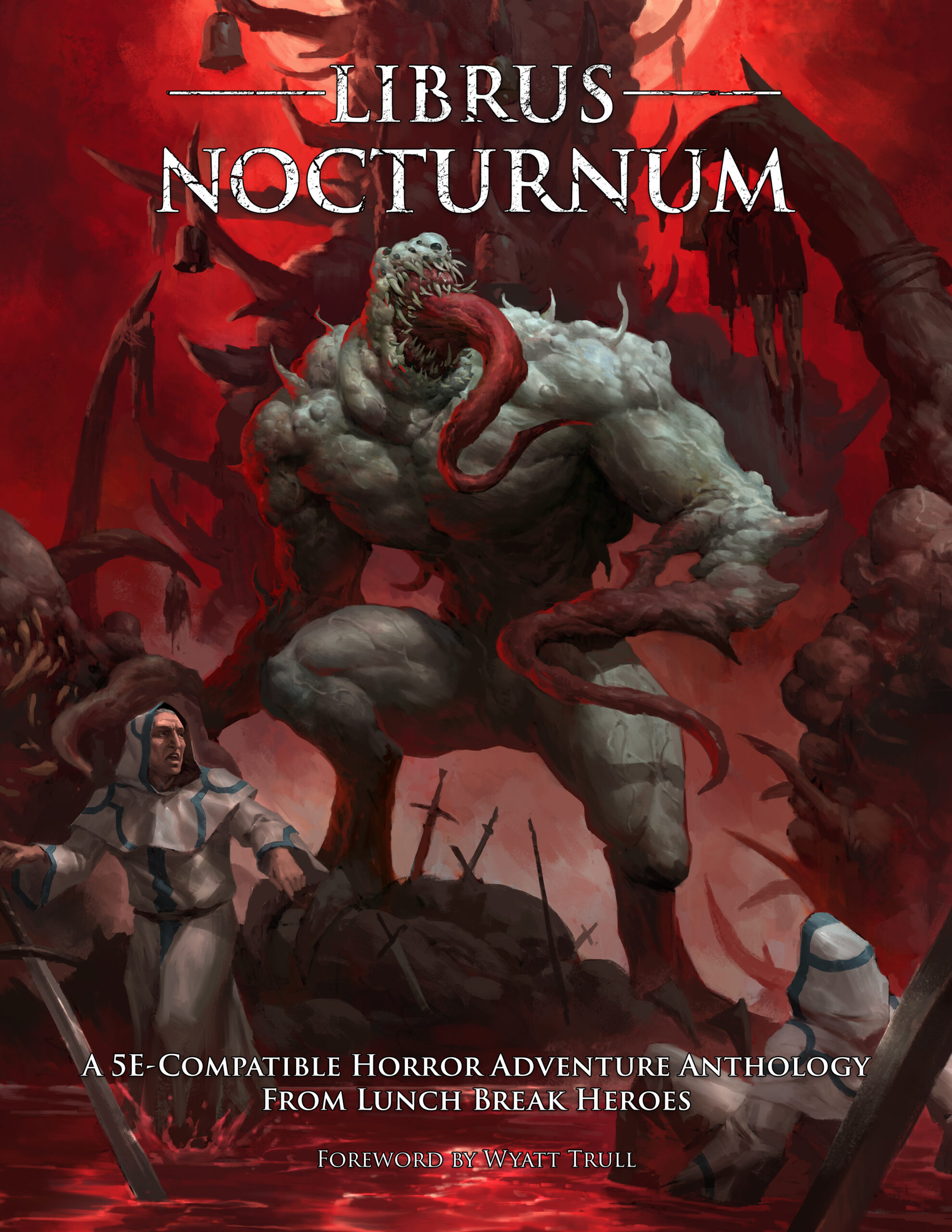
Disclosure: I received a complimentary digital copy of Librus Nocturnum from Lunch Break Heroes for review consideration. No additional expectations were set, and all opinions are my own.
Horror is an awkward guest at the Dungeons & Dragons table.
The system is built for competence, escalation, and eventual mastery. Characters grow tougher, spells grow louder, and threats that once felt existential eventually become solvable with preparation and the right spell slot. That structure serves heroic fantasy extremely well, but it leaves little room for hesitation, uncertainty, or dread.
Most adventure design leans into those strengths. Librus Nocturnum does not.
Rather than attempting to retrofit horror into a power fantasy, the book approaches the problem from the opposite direction.
Rather than attempting to retrofit horror into a power fantasy, the book approaches the problem from the opposite direction. It assumes discomfort. It assumes restraint. And it assumes a Dungeon Master willing to let tension do more work than spectacle.
This Creator Spotlight exists not because Librus Nocturnum is popular or flashy, but because it is unusually honest about what it is trying to do; and what it is not. It does not promise safety, balance, or catharsis on demand. Instead, it asks whether D&D can be bent, carefully, deliberately, into a shape that supports horror without collapsing under its own mechanics.
To understand that choice, it helps to understand the designer’s relationship with power fantasy itself.
Horror Without the Power Fantasy
When asked whether moments of restraint or discomfort in Librus Nocturnum were deliberate design decisions, Steve’s answer was blunt, and revealing.
“I’ve never been in love with power fantasies… There’s no real way to do horror if the players can nuke their way through every problem. So one must face players with problems that can’t be solved with a fireball.”
Steve, Lunch Break Heroes
That framing matters. Restraint, in this case, isn’t a technique layered onto the system. It’s a consequence of taste. Horror requires friction. It requires situations where power doesn’t immediately translate into control, and where the most obvious solution is often the wrong one.
Tales & Tankards Note: This is the throughline I kept seeing across the book: threats that escalate sideways rather than upward; problems that pressure choices, relationships, and conscience more than hit points.
This philosophy runs through Librus Nocturnum quietly but consistently. Many of its conflicts resist clean resolution. Threats escalate sideways rather than upward. The danger often lies not in what the party can see, but in what they are forced to tolerate, enable, or leave unresolved.
“D&D, as a system, is a terrible fit for a horror game.”
Steve, Lunch Break Heroes
Steve is also candid about the limits of the medium itself. Fifth Edition is designed to empower players, reward optimization, and provide frequent release valves for tension. That doesn’t make horror impossible, but it does mean horror must fight the system at every turn.
Librus Nocturnum exists in that tension. It uses D&D not because it is ideal, but because it is familiar, commercially viable, widely understood, and flexible enough to be pushed against its own grain. The result is not a rejection of heroic fantasy, but a refusal to rely on it.
Trusting the Dungeon Master
One of the most striking qualities of Librus Nocturnum is what it doesn’t do.
It does not provide step-by-step instructions for maintaining tension. It does not script emotional beats or prescribe table behavior. Instead, it presents scenarios, often richly detailed, and trusts the Dungeon Master to decide how they unfold.
“I find prescriptive styles to be a mark of an inexperienced designer… The more prescriptive a design is, the more it intrudes into the personalized story that is being told at the table.”
Steve, Lunch Break Heroes
That philosophy draws a clear line between guidance and intrusion. Too little detail, and an adventure becomes unusable. Too much, and it begins to compete with the table’s own storytelling instincts. The balance Librus Nocturnum strikes leans toward trust, sometimes uncomfortably so.
On editing: Steve describes shaping drafts as “literary surgery” – taking verbose writing and cutting it down to the necessary parts.
The result is a book that assumes competence. It expects the Dungeon Master to read tone, manage pacing, and know when to pull back rather than push forward. For some tables, that expectation will feel empowering. For others, it may feel demanding.
But it is never accidental.
By refusing to over-prescribe horror, Librus Nocturnum places responsibility where it believes it belongs: not in procedural checklists, but in the hands of the person running the game.
Horror Lives in People, Not Monsters
One of the more unsettling realizations that emerges while reading Librus Nocturnum is how rarely its most effective horror comes from stat blocks.
The monsters matter, but they are rarely the point.
Again and again, the book’s tension is carried instead by people: NPCs who compromise, rationalize, delay, or quietly accept the unacceptable. These characters are not simply quest-givers or victims. They are pressure points. They exist to complicate moral clarity and force players into decisions that feel human rather than heroic.
“You cannot make a player afraid of something. But you can make them afraid for someONE.”
Steve, Lunch Break Heroes (paraphrasing Stephen King)
This is where Librus Nocturnum does some of its quietest and most effective work. Its NPCs are not caricatures. They are tired, compromised, frightened, or convinced they are doing the best they can under impossible circumstances. The horror does not come from their monstrosity, but from their proximity.
DM Tip: If you want these adventures to sing, invest early in the NPCs. Give the table someone to protect, and someone to doubt.
At the table, that design choice shifts the Dungeon Master’s role. Horror isn’t delivered through surprise, it’s cultivated through relationship. The book provides the raw material, but it relies on the DM to let those relationships breathe long enough to matter.
An Anthology by Design, and by Limitation
Librus Nocturnum presents itself clearly as an anthology, and it embraces both the strengths and weaknesses of that format.
There is no framing narrative that ties the adventures together. No overarching villain. No implied progression from chapter to chapter. Each scenario stands alone, unified more by tone than by plot.
“This is probably one of the weakest parts of the book. There’s no framing narrative that ties everything together.”
Steve, Lunch Break Heroes
Without connective tissue, the responsibility of cohesion shifts entirely to the Dungeon Master. Picking individual adventures to drop into an ongoing campaign works well; weaving them into a unified arc requires additional effort.
Practical takeaway: Treat this book like a cellar of dark vintages. Pick what fits your campaign’s palate, and don’t feel compelled to serve every bottle in order.
Rather than positioning the book as something it isn’t, Librus Nocturnum makes a clear trade: flexibility in exchange for structure. It gives DMs permission to curate rather than consume wholesale. Some will run a single chapter as a tonal detour. Others will stitch several together into a longer descent. Both approaches are valid, but neither is done for you.
For readers looking for a campaign-in-a-box, this may be a point of friction. For those comfortable treating adventures as ingredients rather than instructions, it is a feature, not a flaw.
Atmosphere, Pacing, and the Space to Breathe
If Librus Nocturnum has a single throughline beyond discomfort, it is restraint, not just in power, but in tone.
Despite its subject matter, the book does not advocate relentless darkness. Horror, Steve argues, cannot survive saturation. If everything is bleak, nothing feels sharp.
“Moments of levity and breaks in tension are important, as their light casts the shadows in which our horrors creep.”
Steve, Lunch Break Heroes
This perspective reframes horror not as a constant state, but as a rhythm. Tension builds, releases, and builds again. Silence matters. Contrast matters. Even humor has a place, not as relief from horror, but as the thing that makes horror visible when it returns.
This emphasis on pacing places further trust in the Dungeon Master. It assumes an ability to read the table, recognize fatigue, and know when to step back rather than push forward. The book provides atmosphere, but it does not dictate tempo.
At-the-Table Principle: Don’t play it “dark” every minute. Play it in contrast. Let the room breathe, then close the door.
From Intent to the Table
Librus Nocturnum is not difficult to understand. It is difficult to run well.
That distinction is deliberate.
As a design exercise, the book makes its priorities clear: discomfort over dominance, atmosphere over spectacle, and trust in the Dungeon Master over procedural control. It resists the power fantasy not by negating it, but by refusing to rely on it. In doing so, it asks more of the person behind the screen, and promises more in return.
What this spotlight has examined is intent: why the book is shaped the way it is, what assumptions it makes about play, and what kind of table it imagines. Whether that philosophy translates cleanly to any given group is another question entirely.
In the next piece, Librus Nocturnum at the Table, I’ll set design theory aside and look at Librus Nocturnum as a practical tool. How much preparation does it demand? Where does it reward confidence, and where does it push back? What kind of Dungeon Master, and what kind of group, is it actually for?
That is a different test.
Part Two: Librus Nocturnum at the Table will take up those questions directly, examining the book not as an idea, but as something meant to be run, adapted, and tested under live play pressure.