DM’s Corner • Series • Table Handouts
Table Handouts: Using Physical Items at the Table
When and Why, Paper Does More Work Than Words
The first time my players entered Waterdeep, I didn’t describe the city gates.
Instead, I handed them paperwork.
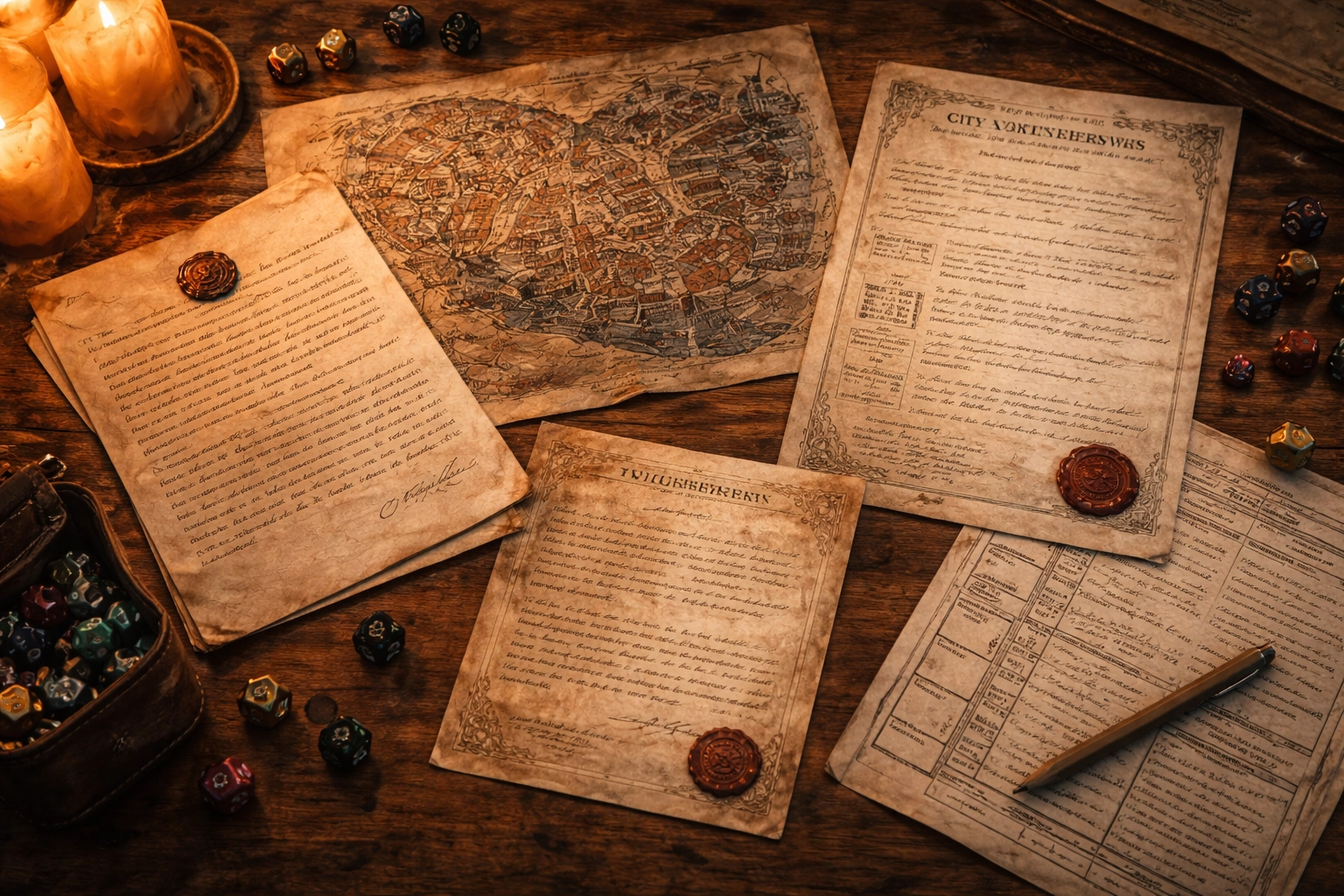
Before they met a single NPC or heard a word of exposition, a pair of bored customs officials slid a form across the table and asked them to fill it out. Names. Origins. Declared goods. A few lines that were intentionally vague. A few that were suspiciously specific. Along with it came a copy of the Code Legal—dry, official, and very clear about the consequences of poor decision-making.
The table reaction was immediate.
Players leaned in. They read ahead. They asked questions—not about the world, but about what they were allowed to write. Someone joked about lying. Someone else pointed out a clause in the Code Legal they hadn’t noticed at first. For the next several sessions, whenever the party skirted the law, that same document came back out. Not because I reminded them—but because they remembered it existed.
That moment crystallized something I’d been circling for years:
I don’t use physical handouts to increase immersion. I use them to change how players interact with information.
When information lives only in the DM’s voice, it’s ephemeral. It can be misheard, forgotten, reinterpreted, or quietly ignored. When it exists as an object—something handed across the table—it gains weight. Players reread it. Argue with it. Hold it up and point to specific lines. The responsibility for remembering and interpreting that information shifts away from the DM and onto the world itself.
That’s the real value of physical handouts.
Not every letter, map, or scrap of parchment deserves to be printed. In fact, most things don’t. But when a piece of information is meant to persist—when accuracy matters, or authority matters, or the world needs to speak for itself—putting something tangible in your players’ hands can quietly do more work than pages of narration ever could.
This article isn’t about making fancy props or crafting museum pieces. It’s about knowing when to stop describing and start handing something over—and how a small stack of paper can change the way a table plays.
In one sentence: Handouts aren’t about realism—they’re about responsibility. They move information out of the DM’s mouth and into the world.
The Hand-It-Over Threshold
Not everything deserves to be printed.
That sounds obvious, but it’s the mistake most DMs make when they first start experimenting with physical handouts. Once you see how effective a single piece of paper can be, the temptation is to externalize everything—every letter, every clue, every scrap of lore. The table fills with parchment, and suddenly nothing feels special anymore.
Over time, I stopped asking “Would this be cool as a prop?” I started asking a different question:
At what point does this information stop belonging to me and start belonging to the world?
That question—more than aesthetics or immersion—is what determines whether something earns a physical form at my table.
Information That Wants to Leave the DM’s Mouth
When information exists only in narration, it is fragile. It depends on memory, attention, and repetition. Players ask you to repeat it. You paraphrase it differently each time. Details soften. Intent blurs.
The moment a piece of information needs to be referenced again, argued over, interpreted differently by different players, or enforced without DM intervention, it starts pushing toward paper.
This is the threshold where a handout stops being flavor and starts being infrastructure.
Four Signals That It’s Time to “Hand It Over”
I don’t follow a checklist at the table, but looking back, almost every successful handout I’ve used crossed at least one of these lines.
1) Persistence Matters
If the party will need this information later—and later again—memory shouldn’t be the bottleneck.
Directories, ledgers, inspection reports, guild paperwork, maps of civic spaces: these aren’t dramatic objects, but they do quiet, consistent work. They let players reorient themselves without interrupting play or leaning on the DM.
If a player says, “Wait, didn’t we see something about this before?” that’s often the moment a future prop reveals itself.
2) Authority Needs a Voice
Rules feel different when they come from paper instead of the DM.
A city’s laws, a deed of ownership, an official summons, a stamped inspection report—these objects don’t argue. They don’t negotiate. They simply exist. When players push against them, they’re pushing against the world, not the person running it.
This is why bureaucratic props work so well. They replace enforcement with implication.
The DM stops being the referee. The document does the talking.
3) Interpretation Is the Point
Some information isn’t meant to be delivered cleanly. It’s meant to be misread, debated, re-examined, and held up under scrutiny.
Letters, broadsheets, contracts, coded notes—these work best when players can point to specific lines and disagree about what they mean. That kind of interaction is difficult to sustain verbally. On paper, it happens naturally.
If the discussion around the information matters more than the information itself, that’s a strong case for a handout.
4) The Object Exists in the World
Sometimes the deciding factor is simply this: the thing already exists in the fiction.
A ledger on a desk. A notice on a wall. A form slid across a counter. A deed signed and filed. When an object has a clear, mundane place in the world, making it tangible reinforces that mundanity—and mundanity is often what sells scale.
Not every relic needs to be dramatic. Some of the most effective props I’ve used were aggressively boring.
Quick rule: If the handout won’t be referenced, argued over, or used to enforce reality later, it probably belongs in narration—not in your printer tray.
What This Threshold Protects You From
Just as important as what this section encourages is what it quietly discourages.
If a piece of information will be used once, exists only for flavor, relies on tone rather than text, or is better delivered through performance, it usually stays in my notes.
This threshold isn’t about doing more work. It’s about doing less repetition and letting the table shoulder part of the cognitive load.
Once you start using this threshold consistently, something interesting happens. Players stop asking, “What did you say that was again?” They start asking, “Where’s the paper?”
That shift—from spoken explanation to shared artifact—is where physical handouts do their best work. Not because they’re immersive, but because they redistribute responsibility at the table.
What I Stopped Turning Into Physical Props
Once you start seeing how effective a single handout can be, it’s easy to overshoot. I did.
For a while, every letter felt like it deserved paper. Every scrap of lore wanted a parchment texture. Every NPC message looked like a potential prop. The table filled with artifacts—and paradoxically, they started to matter less.
Over time, I learned that restraint isn’t just a production concern. It’s a design choice.
Here are the categories of things I stopped making physical—and why.
One-Off Information
If a piece of information will be delivered once and never referenced again, it rarely earns a physical form. This includes single-scene exposition, travel narration, transitional clues, and flavor text meant to set mood and then disappear.
Paper implies persistence. When you hand something over, players assume it matters later. If it doesn’t, the prop creates a promise the game never intends to keep.
In those cases, spoken description is actually clearer and kinder.
NPC Personality and Voice
I experimented briefly with written NPC monologues, diary excerpts, and personality notes. They were fine. They were also worse than performance.
Tone, cadence, hesitation, humor—these are things the table reads from you, not from text. When personality matters more than precision, paper gets in the way.
I still use letters and written messages—but only when the content matters more than the delivery. If the delivery is the point, it stays verbal.
Rules Explanations
It’s tempting to turn house rules, local laws, or mechanical clarifications into handouts. Occasionally that works—especially for authority documents like legal codes—but most rules explanations are better handled through play.
Handing players a rules document often signals that the game is about to slow down. If a rule needs reinforcement, I’d rather let the world demonstrate it: consequences instead of clauses, reactions instead of reminders, enforcement instead of explanation.
Paper is heavy. Rules are already heavy enough.
Puzzle Instructions (But Not Puzzle Components)
I stopped handing out instructions for puzzles. Instead, I hand out components.
Diagrams, symbols, fragments, coded text—those live happily on paper. Step-by-step explanations do not. When players receive written instructions, the puzzle often collapses into compliance instead of exploration.
If players ask, “What are we supposed to do with this?” that’s usually a sign the prop is doing the wrong job.
Anything Players Won’t Touch
If a handout will sit in the center of the table untouched while players keep looking at you, it doesn’t belong in physical form. That usually means overly dense text, decorative props with no function, or lore dumps disguised as artifacts.
A good handout invites interaction. A bad one becomes scenery.
If the prop doesn’t replace something I’d otherwise have to repeat or enforce, it probably doesn’t earn its ink.
Every physical object you introduce competes for attention. When everything is special, nothing is. By being selective—by letting many things remain ephemeral—you protect the weight of the few artifacts that do cross the threshold.
Designing for the Table You Actually Have
It’s easy to design handouts for a hypothetical table. Good lighting. Unlimited prep time. Players who take pristine notes. Plenty of space. Everyone engaged in exactly the way you imagined. That table exists—just not very often.
The handouts that survive long-term are the ones designed for the table you actually sit at.
Over time, I stopped asking whether a prop was clever or atmospheric and started asking a more practical question: will this still work once dice, drinks, kids, side conversations, and time pressure enter the room?
Time Is the First Constraint
Handouts are supposed to save effort at the table, not create new work behind the screen. Some of my earliest props took hours to make and minutes to use. Those didn’t last.
The ones that stuck were quick to prepare, easy to reproduce, and reusable with minimal tweaking. Simple layouts. Clear text. Fast printing. Those choices aren’t compromises—they’re survival traits.
Lighting and Readability Matter More Than Aesthetics
Dim rooms, overhead glare, candlelight, cluttered tables—this is normal play space, not a studio shoot. Highly decorative fonts, parchment textures, and low-contrast text look great on screen and fail miserably under real conditions.
Legibility over mood. Spacing over density. Clarity over cleverness. If players have to squint or ask you to read it for them, the handout has already failed.
Not Every Player Engages the Same Way
Some players will pore over every document. Others will glance once and wait for someone else to summarize. That’s not a flaw—it’s a reality.
Good handouts tolerate uneven engagement. They don’t require every player to read them closely. They reward the ones who do without punishing the ones who don’t. One player becomes the “paper person.” The table adjusts. Play continues.
Kids, New Players, and Cognitive Load
At mixed-experience tables—or tables with younger players—physical objects can be grounding, but they can also overwhelm. Dense documents, layered meaning, or multiple simultaneous handouts increase cognitive load quickly.
I’ve learned to introduce handouts one at a time, with space between them, and to let players set the pace of interaction. Silence while people read isn’t dead time—it’s processing time.
In-Person vs. Remote (And Why This Still Matters)
Even when games move online, physical handouts don’t stop being useful. Scanned forms, shared PDFs, screenshots—these are still objects players can reference independently. The same design principles apply: clarity, persistence, and function over flair.
The difference is distribution, not philosophy.
Designing for Friction, Not Perfection
Paper gets lost. Pages get bent. Someone spills a drink. A handout disappears between sessions. That’s not failure. That’s evidence the object entered the world.
If a prop can’t survive mild chaos, it’s too precious. The best handouts feel replaceable even when they’re meaningful.
Real-table checklist: Can it be read in dim light? Reprinted quickly? Understood by a distracted table? Survive a spilled drink? If not, simplify.
Paper Trails and Living Worlds
When a campaign ends, most of what happened lives on in memory. Moments blur. Scenes compress. Details soften. What remains are feelings, highlights, and a handful of shared stories that get retold slightly differently each time.
Physical handouts behave differently.
They linger.
Long after the dice stop rolling, the paper remembers.
A folded form in a binder. A creased letter tucked into a folder. A deed signed months ago. These artifacts don’t just remind players of what happened—they anchor it. They preserve decisions in the state they were made, without revision or reinterpretation.
Objects Carry Accountability
There’s a subtle but important shift that happens when a campaign leaves a paper trail. Players don’t just recall that they were warned about the law—they remember reading it. They don’t just recall owning a building—they remember signing for it. The responsibility for those moments doesn’t live with the DM; it lives with the world.
That accountability changes how players relate to the setting. Choices feel less hypothetical when there’s evidence they happened.
Not Mementos—Artifacts
The most successful handouts I’ve used were never designed as keepsakes. They were tools, meant to be handled, argued over, and eventually forgotten under a stack of character sheets.
And yet, those are the ones that survive. Not because they were ornate or clever, but because they were useful. They existed to do a job at the table, and in doing so, they became artifacts of play rather than souvenirs of prep.
A World That Doesn’t Need Explaining
There’s a quiet confidence in letting the world speak for itself. Forms imply systems. Reports imply oversight. Broadsheets imply competing narratives. Directories imply scale. None of those require explanation once they’re in a player’s hands.
Over time, the table stops asking you to describe the world. They start looking for evidence of it. That’s when a setting begins to feel less like a story being told and more like a place being navigated.
Why This Is an Ongoing Practice
This article isn’t meant to be exhaustive, and it isn’t meant to be definitive. The handouts that earn a place at your table will depend on your players, your pacing, your constraints, and your tolerance for friction. Some will work once and never again. Others will quietly become part of your table’s shared language.
That process—trying, refining, discarding—is the craft. The goal isn’t to create more paper. It’s to know when paper does work that words no longer need to do.
What Remains
In the end, physical handouts aren’t about immersion, realism, or production value. They’re about trust: trust that the world exists beyond the DM’s narration, trust that choices persist, trust that the game leaves marks behind.
When used with intention and restraint, a single sheet of paper can carry more weight than a paragraph ever could.
And when the campaign is over, those quiet artifacts are often what remain—proof that the world was there, and that the table changed it.