
DM Corner • Creator Spotlight • Eventyr Games
DELVE — How to Build & Survive Deadly Dungeons
Some books teach you rules.
Some books hand you content.
DELVE does something rarer, it teaches you how to think like a dungeon designer again.
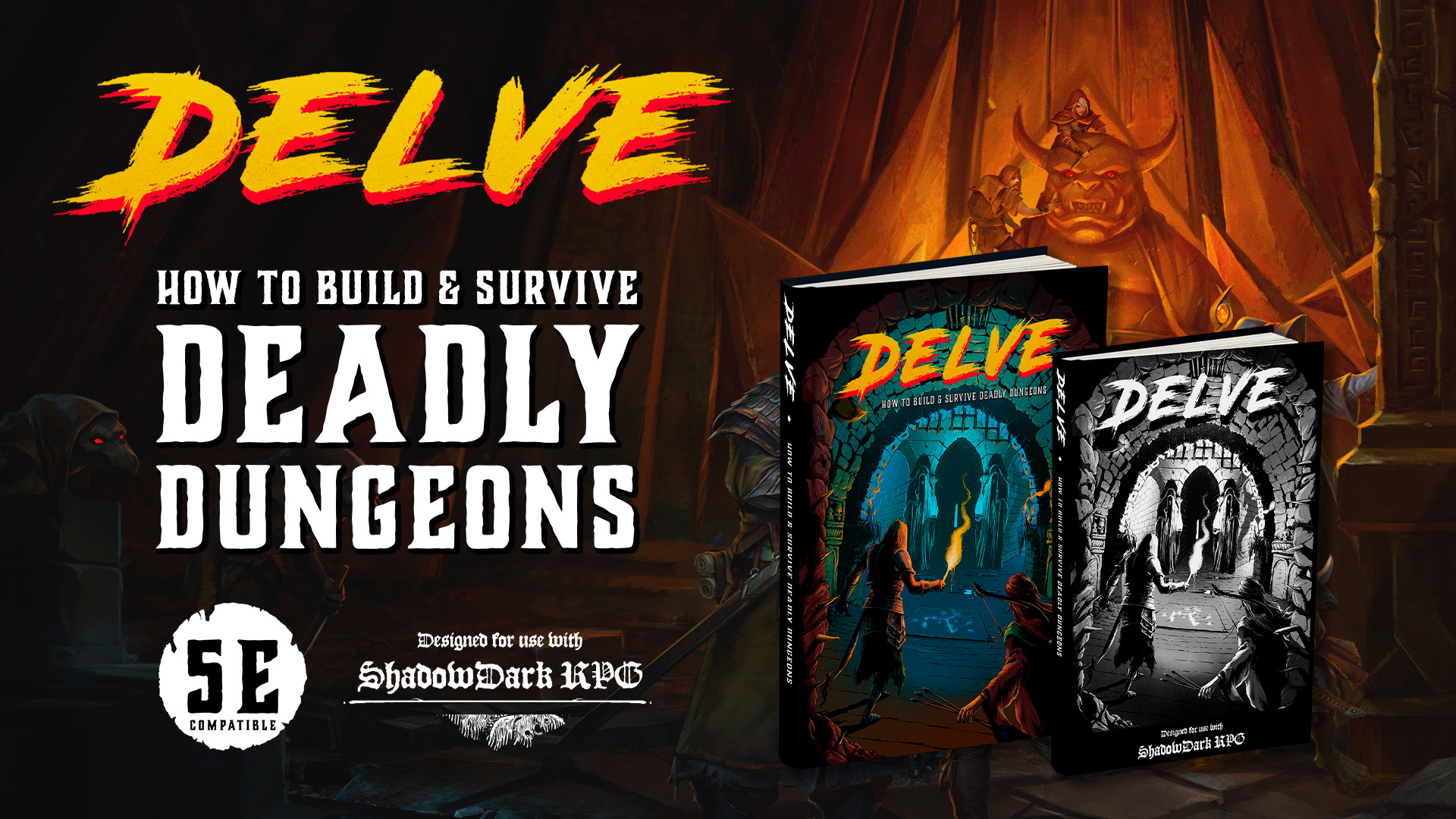
Published by Eventyr Games, DELVE: How to Build & Survive Deadly Dungeons is a 264-page love letter to the dungeon as both a mechanical structure and a narrative space. It is not just a toolkit, and it’s certainly not a grab-bag of random tables. Instead, DELVE feels like the result of decades spent running dungeons, breaking them, rebuilding them, and asking a deceptively simple question: Why do we keep going back underground?
“DELVE doesn’t just explain how to build dungeons; it reconnects dungeon design to why players keep coming back underground in the first place.”
Eventyr Games: Design in Service of Play
Eventyr Games has built a reputation on adventures and supplements that prioritize clarity at the table. Their products consistently aim to reduce friction for the GM without stripping away the creativity that makes tabletop roleplaying compelling.
DELVE exemplifies that ethos. Designed by J. A. Valeur, Robert Mason (Bob World Builder), and S. K. Valeur, with contributions from a wide circle of respected designers and creators, the book is grounded in lived play experience rather than abstract theory. It openly acknowledges its influences, Return of the Lazy Dungeon Master, Dungeon Crawl Classics, Shadowdark, Index Card RPG, while confidently forging its own voice.
This is not nostalgia for nostalgia’s sake. DELVE looks backward only to better understand why certain dungeon experiences still work, and how to recreate them for modern tables with modern expectations.
What DELVE Actually Is
At its core, DELVE is a dungeon-thinking manual wrapped around a generous amount of ready-to-use content. It doesn’t ask you to choose between theory and application; it insists that the two belong together.
The book is divided into four major sections:
Master the Dungeon
This opening chapter is the philosophical heart of DELVE. Before a single stat block appears, the book takes time to examine what dungeons are4, as spaces, as challenges, and as engines of play.
One section that resonated strongly with me is its discussion of dungeon types. DELVE doesn’t present these as rigid categories, but as lenses through which a GM can understand player expectations and pacing. Linear dungeons, five-room dungeons, symmetrical designs, nonlinear “Jaquaysed” spaces, each is treated not as a formula to follow blindly, but as a tool with strengths, weaknesses, and best-use cases.
What makes this work is the framing. DELVE doesn’t ask, “Which dungeon is best?”
It asks, “What kind of experience are you trying to create?”
“DELVE doesn’t ask which dungeon is best. It asks what kind of experience you want your players to have.”
A linear dungeon might be perfect as a palate cleanser between complex story arcs. A five-room dungeon excels at onboarding new players. A sprawling nonlinear complex rewards curiosity, caution, and player-driven problem solving. These ideas aren’t revolutionary, but the way DELVE contextualizes them is deeply practical. It reconnects dungeon structure to player decision-making, which is where dungeons either come alive or fall flat.
The chapter then transitions into a structured approach to dungeon creation, including a step-by-step dungeon generator. Importantly, this generator doesn’t replace creativity, it scaffolds it. You’re never told what your dungeon must be, only given enough structure to move forward confidently.
Dungeon Delvers
Rather than bloating player options, DELVE keeps this section focused and intentional. It introduces a small set of feats, species, and subclasses designed specifically to interact with dungeon play.
These options emphasize exploration, risk management, and problem-solving over raw combat escalation. They feel purposeful, tools for dungeon-focused campaigns, not generic power upgrades. If your table enjoys dungeons as more than just a series of fights, these options reinforce that style of play rather than undermining it.
Twelve Ready-to-Run Dungeons
This is where DELVE quietly outclasses many supplements in its category.
The twelve dungeons included span levels 1–10 and are presented in ascending order of difficulty. Each dungeon includes:
- A clear thematic identity
- A concise overview with estimated playtime
- Encounter breakdowns (combat, social, dangers, puzzles)
- Guidance for adjusting difficulty using Total Party Level
What stood out to me is how readable these dungeons are during play. Formatting choices, bolding, and layout all exist to answer a single question in the moment: What do I need right now to keep the game moving?
“Every layout and formatting choice in DELVE exists to answer a single question at the table: what do I need right now?”
These aren’t disposable one-shots. They’re modular locations that can anchor an ongoing campaign or slot cleanly into an existing world with minimal effort.
Challenges & Discoveries
The final section is a GM’s utility belt: monsters, magic items, traps, hazards, riddles, rival adventurers, dungeon-adjacent shops, and even rules for friendly dungeon-delving contests.
Everything here is written with reuse in mind. Nothing feels precious or overly bespoke. This is content meant to be pulled, reskinned, and dropped wherever it’s needed, exactly the kind of material that sees repeated use long after the initial read-through.
Who This Book Is For
DELVE is explicitly written for dungeon-focused play, but its audience is broader than that label suggests.
This book is for:
- New GMs who find dungeon design intimidating and want guidance without being overwhelmed.
- Veteran GMs who have run dozens of dungeons and want to rediscover why some worked better than others.
- Worldbuilders who care about how locations shape stories, not just how they look on a map.
- Urban or intrigue-focused campaigns that still rely on occasional dungeon spaces and want those spaces to matter.
Perhaps most importantly, DELVE is for GMs who value player agency. Its advice consistently reinforces meaningful choice, readable risk, and the idea that a dungeon should respond to player decisions rather than simply absorb them.
What DELVE Is Not
Just as important as what DELVE does well is what it deliberately avoids.
- DELVE is not a megadungeon.
It doesn’t expect you to commit to a single colossal location for an entire campaign. - It is not a random table compendium.
The generators and tools exist in context, always tied back to purpose and play experience. - It is not trying to replace the GM.
DELVE assumes you have ideas worth expressing, it simply helps you express them more clearly at the table. - And it is not a system-locked rulebook.
While fully compatible with both 2014 and 2024 5E, its best ideas transcend any single ruleset.
“DELVE supports without overshadowing, guides without dictating, and trusts the GM to make the final call.”
This restraint is one of the book’s greatest strengths. DELVE never feels like it’s competing for control of your game. It supports without overshadowing, guides without dictating, and trusts the GM to make the final call.
Why DELVE Stands Out
What impressed me most while reading DELVE wasn’t its size or scope, it was its intentionality.
Every section feels written by people who have run games for real players, in real time, under real pressure. Layout, language, and structure all respect the GM’s limited attention during play. This is a book designed to be used, not just admired.
DELVE understands that dungeons are not just obstacles to be cleared. They are spaces where tension builds, choices matter, and stories emerge organically from play. That understanding permeates every chapter.
“This is a book written by people who have run real games, for real players, under real pressure.”
Final Thoughts (For Now)
DELVE is not just for dungeon-heavy campaigns. It’s for any GM who wants their locations to feel intentional, their encounters meaningful, and their prep time rewarded at the table.
Eventyr Games has created something that teaches without lecturing, inspires without dictating, and supports without replacing the GM’s voice. That’s a difficult balance to strike, and DELVE strikes it confidently.
In Part Two, I’ll take a closer look at how DELVE performs in active play: which sections shine brightest during prep, which tools I reach for mid-session, and how this book complements long-form campaigns built around urban intrigue, classic dungeon crawls, or megadungeon-adjacent play.
For now, suffice it to say:
DELVE understands why we keep going back underground, and it shows.