
DM Corner • Creator Spotlight • Eventyr Games
Using DELVE at the Table: Prep, Play, and Practical Value
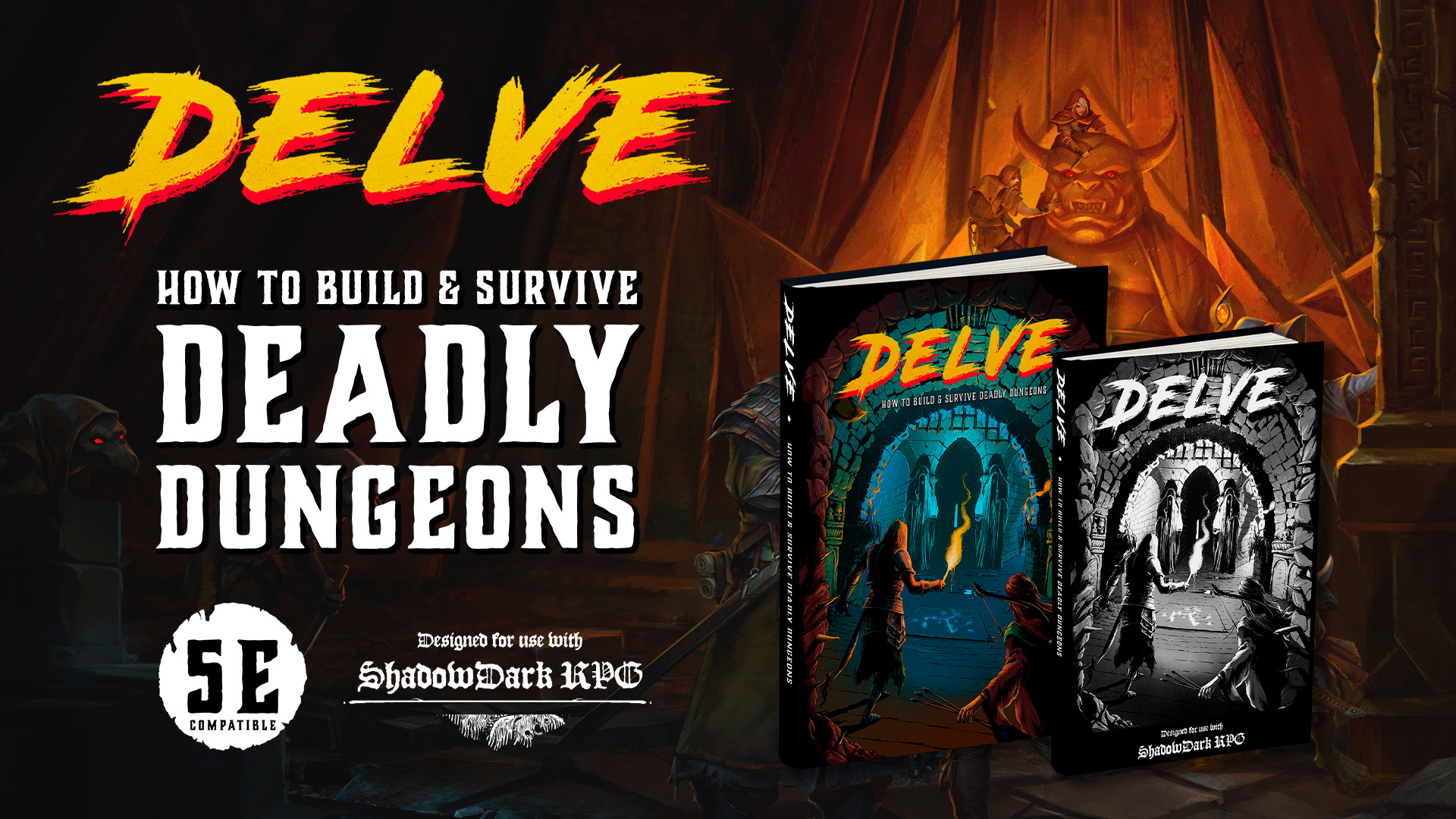
Reframing the Question: How Does DELVE Actually Get Used?
By the time a Dungeon Master reaches for a book like DELVE, they are usually past the point of needing permission to run dungeons.
The real question isn’t “What is this book about?” It’s “When does this book come off the shelf?”
Most GM resources fall into one of two categories: books you read once and internalize, or books you reference constantly but rarely enjoy revisiting. DELVE occupies a more interesting space between those extremes. It’s a book you can read cover to cover, but, more importantly, it’s a book you return to when the game is already in motion.
That distinction matters.
This second part of the Creator Spotlight isn’t about re-evaluating design philosophy or summarizing contents. That work was done in Part One. This is about use, about where DELVE fits into real GM workflow: late-night prep, mid-session improvisation, and those in-between moments where you know you need a dungeon but haven’t yet decided what shape it should take.
So instead of asking whether DELVE is well written or thoughtfully designed, the better question becomes:
When I’m running an active campaign, what does DELVE actually help me do?
“The real question isn’t what DELVE is about, it’s when it comes off the shelf.”
Prep Night vs. Game Night: Where DELVE Lives
One of the quickest ways to tell whether a GM book has staying power is noticing when you reach for it.
Some books live exclusively on prep night. Others survive contact with players. DELVE manages to do both, but in different ways, at different times.
Prep Night: Getting Unstuck
During prep, DELVE functions as scaffolding. Not a script, not a checklist, something closer to a way to regain momentum when the blank page starts pushing back.
The dungeon generator and dungeon-type discussions are especially effective here. They don’t ask you to surrender creative control; instead, they narrow the field just enough to make forward motion possible. You stop asking “What should I build?” and start asking “What kind of experience do I need right now?”
That shift is subtle but powerful. Dungeon prep stops feeling like a creative burden and starts becoming a series of intentional choices. The result is faster starts, cleaner concepts, and far less overbuilding.
Game Night: Surviving the Table
What surprised me more is how often DELVE holds up during play.
This isn’t a book you constantly flip through mid-session, but when you do open it, it’s because you need clarity quickly. The ready-to-run dungeons, encounter summaries, and challenge sections are laid out with real table pressure in mind. You’re not rereading paragraphs; you’re scanning for answers.
That distinction matters. DELVE doesn’t try to be omnipresent during play. It steps in only when needed and then gets out of the way.
In that sense, it behaves less like a reference manual and more like a trusted notebook: something you know how to use because it respects how you actually run games.
Dungeon Types as a Mental Shortcut
Why This Section Changed How I Think
Of all the material in DELVE, the discussion of dungeon types had the most lasting impact on how I approach dungeon design.
Not because the concepts were new, but because of how they were framed.
DELVE presents dungeon types not as formulas to follow, but as experience-shaping tools. Linear dungeons, five-room dungeons, nonlinear complexes, each carries implicit promises about pacing, player agency, and cognitive load. Choosing one becomes less about tradition and more about intent.
“Dungeon types aren’t formulas in DELVE, they’re experience-shaping tools.”
That reframing quietly solves a problem many GMs don’t realize they’re having.
When a campaign needs a dungeon, especially a side dungeon or transitional space, the instinct is often to overbuild. More rooms. More branches. More encounters. DELVE instead encourages a simpler, more productive question:
What do my players need from this dungeon right now?
A linear dungeon can be a relief after a dense social arc. A five-room dungeon can deliver structure and satisfaction in a single session. A nonlinear dungeon rewards caution and curiosity when players are energized and invested. None of these are “better,” they’re appropriate at different moments.
What changed for me wasn’t how I build dungeons, but how I choose them.
That mental shortcut, selecting a dungeon structure based on desired experience, has ripple effects. Prep becomes faster. Player decisions feel more legible. And dungeons stop feeling like obligatory content and start feeling intentional again.
It’s a small conceptual shift, but one that sticks, and it’s a clear example of what DELVE does best.
The Ready-to-Run Dungeons: What Holds Up Under Pressure
Reading a dungeon and running a dungeon are very different experiences.
DELVE’s twelve ready-to-run dungeons read cleanly on the page, but more importantly, they hold together once the dice hit the table. That may sound like a low bar, but it’s one many published dungeons quietly fail to clear.
Each dungeon is framed with clarity. Overviews establish intent before detail. Estimated playtime and party-level guidance set expectations early. You know what kind of session you’re about to run before you ever look at a map.
Once play begins, the layout continues to do quiet work. Encounters are structured for scanning rather than rereading. Hazards, puzzles, and combat elements are distinct without being siloed, which makes it easier to react when players inevitably go off script.
“DELVE’s dungeons don’t collapse under pressure, they flex.”
When that happens, DELVE’s dungeons don’t collapse; they flex. Because the dungeons are built around ideas rather than scripts, it’s easy to reorder spaces, adjust encounters, or let consequences ripple outward without losing coherence.
Equally important, these dungeons adapt well to existing worlds. Dropping one into an ongoing campaign doesn’t feel like grafting on foreign material; it feels like uncovering a place that was always just off the map.
The Tools I Keep Coming Back To
Long after the first read-through, certain sections of DELVE start to earn bookmarks.
For me, the long-term value comes from the supporting tools, not the headline features. The dungeon generator is an obvious example, it’s fast, flexible, and easy to bend to your needs, but it’s far from the only repeat-use section.
The hazards and traps stand out because they’re framed as environmental problems rather than punishments. They create tension without defaulting to damage, which makes them easier to integrate into exploration-focused play.
The rival adventurers section is another quiet standout. It provides just enough structure to introduce meaningful competition without requiring extensive NPC tracking. Rivals can become antagonists, foils, or uneasy allies, and they slot naturally into dungeon-focused campaigns without derailing them.
Even smaller inclusions, like dungeon-adjacent shops or contest rules, signal something important: DELVE understands that dungeon play doesn’t exist in a vacuum. It’s connected to downtime, reputation, logistics, and the wider world.
These are the pages that don’t just get read; they get reused.
What DELVE Does Better Than Most GM Books
DELVE doesn’t try to outdo other GM resources by being bigger, louder, or more exhaustive.
It succeeds through restraint.
Where many GM books overwhelm with options, DELVE curates. Where others chase novelty, it focuses on fundamentals. And where some books attempt to replace GM judgment with systems, DELVE consistently trusts the person behind the screen to make the final call.
That trust shows up everywhere:
- Tools that scaffold rather than dictate
- Dungeons that emphasize intent over scripting
- Advice that explains why something works, not just how
Perhaps most importantly, DELVE respects the GM’s time. It assumes prep happens in fragments. It assumes sessions get messy. It assumes plans will break.
And instead of fighting those realities, it designs around them.
Where DELVE Might Not Be the Right Fit
As strong as DELVE is, it isn’t trying to be everything for everyone, and that’s a strength, not a flaw.
If you’re looking for a single megadungeon designed to occupy an entire campaign, this isn’t that book. DELVE supports dungeon-heavy play, but its focus is on modular, intentional dungeon experiences, not sprawling labyrinths.
Similarly, GMs who prefer fully procedural generation with minimal interpretation may find DELVE more hands-on than expected. Its tools support judgment rather than replace it, and the book assumes you want to make choices.
And if your ideal dungeon is a pure combat gauntlet with little emphasis on exploration or environmental storytelling, some of DELVE’s strengths may feel understated.
None of this is accidental. DELVE knows exactly what it wants to be, and just as importantly, what it doesn’t.
How DELVE Fits into Long-Form Campaigns
One of DELVE’s quiet strengths is how easily it integrates into ongoing campaigns, even those that aren’t dungeon-centric.
In long-form play, dungeons often serve as punctuation marks rather than centerpieces. They appear between story arcs, beneath cities, or as optional paths players choose to explore. DELVE supports that rhythm well.
Because its advice centers on experience design, it’s easy to scale dungeon complexity to where a campaign currently sits. A short, focused dungeon can provide momentum without derailing the plot. A deeper space can become a temporary anchor when players want to slow down and explore.
Just as importantly, DELVE encourages continuity. Its tools reinforce the idea that dungeons affect the wider world, economically, socially, and narratively, long after they’re cleared.
For campaigns that blend urban intrigue, travel, and exploration, this adaptability matters. DELVE doesn’t demand the campaign bend around it. It bends to fit the campaign you’re already running.
“DELVE doesn’t promise perfect prep. It promises support when plans break.”
Final Thoughts: A Book That Respects the GM’s Time
The strongest impression DELVE leaves isn’t tied to any single dungeon, tool, or subsystem.
It’s about respect.
DELVE respects the GM’s time by presenting information clearly and concisely. It respects the GM’s creativity by offering guidance without dictation. And it respects the table by designing for real play rather than idealized scenarios.
This is a book written by people who understand that Dungeon Masters are constantly balancing preparation, improvisation, and player choice, often all at once. DELVE doesn’t promise perfection. It promises support.
Taken together with Part One, DELVE stands as more than a dungeon supplement. It’s a philosophy of play rooted in intention, clarity, and trust.
If you want your dungeons to feel purposeful, memorable, and worth the time you spend preparing them, DELVE is a resource that earns its place on the shelf. and keeps it.