Homebrew • DM Tips • Character Building
Creating a Character: Ranger – The Patient Hunter
A Campaign-Stable Archer Build Focused on Consistency, Control, and Tactical Flexibility
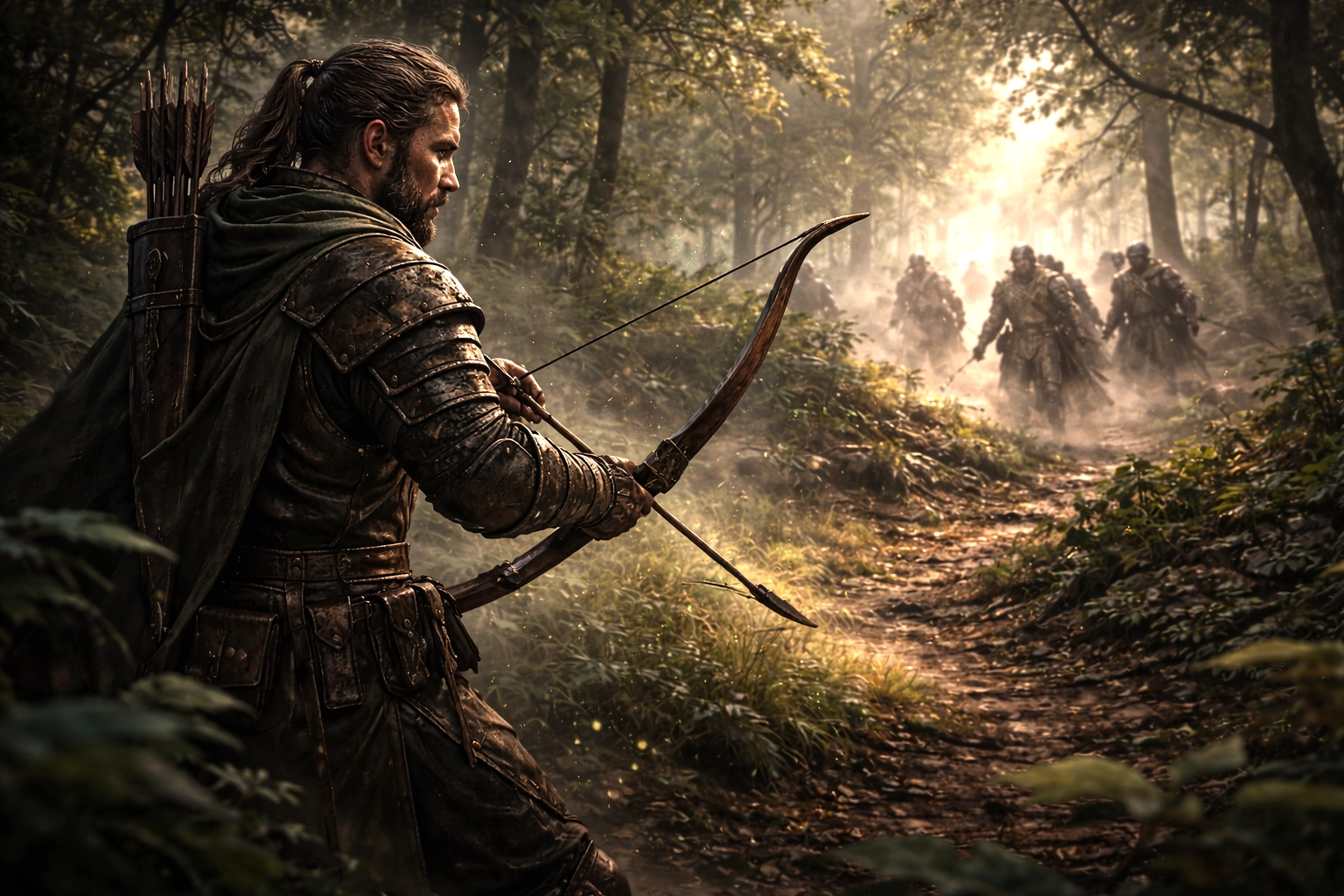
There’s a version of the Ranger that feels incredible at the table, and a version that constantly feels like it’s almost working.
Too many Ranger builds drift into friction with too many bonus action demands, over-reliance on a single damage loop, and features that compete instead of complement
But under the 2024 rules, the Ranger has quietly become one of the most stable, flexible, and table-friendly classes in Tier 1–2 play, if you build it with intention.
Building Better Characters
Great characters aren’t built in a single step; they’re shaped over time.
This three-part series explores how to create a character that not only works on paper, but thrives across an entire campaign:
Part 1: Smart Mechanical Choices That Scale
Part 2: Meaningful Character Identity That Drives Play
Part 3: Table Integration and Long-Term Character Success
Start where you are, or follow the full journey.
This isn’t the flashy nova striker; this is the Ranger that shows up every round, makes smart decisions, and always contributes. This is the Patient Hunter.
The Role: Consistent Pressure, Tactical Awareness, and Quiet Control
The Ranger thrives when played as a decision engine, not a damage spike machine.
You are the party’s most reliable ranged attacker, a battlefield problem-solver, a scout and positioning expert, a control caster when it matters.
You are not a burst-damage specialist, a bonus-action juggling act, a one-trick DPR loop.
The goal is simple: Make the right decision every turn and always have one available.
The Build at a Glance
Core Concept: Dexterity-based archer with sustained damage and flexible spell support
Primary Stat: Dexterity
Secondary Stat: Wisdom
Subclass: Hunter
Fighting Style: Archery
This build avoids complexity traps and leans into like accuracy over volatility, positioning over risk, flexibility over specialization.
Core Loop: Simple, Stable, Effective
At its best, the Ranger turn should feel clean.
Tier 1 (Levels 1–4)
- Bonus Action: Apply Hunter’s Mark (when appropriate)
- Action: Attack with ranged weapon
- Positioning: Stay mobile, maintain sightlines
Tier 2 (Levels 5–10)
- Bonus Action: Maintain or shift Hunter’s Mark
- Action: Extra Attack (increased consistency, not complexity)
- Spell Use: Introduce control when needed (Spike Growth, Pass without Trace, etc.)
This loop works because it doesn’t fight itself.
You’re not choosing between three competing priorities every turn, you’re choosing when to adjust.
“The Ranger doesn’t win by doing more, it wins by always having the right option.”
Ability Scores: Built for Reliability
Point Buy (Recommended)
| STR | CON | DEX | WIS | INT | CHA |
|---|---|---|---|---|---|
| 8 | 14 | 15 | 15 | 8 | 10 |
Background (2024):
- +2 DEX → 17
- +1 WIS → 16
This gives you strong attack accuracy immediately, solid spell DC scaling, durable concentration.
Standard Array Alternative
| STR | CON | DEX | WIS | INT | CHA |
|---|---|---|---|---|---|
| 10 | 13 | 15 | 14 | 8 | 12 |
Slightly behind on Wisdom, but still very stable.
Why Hunter?
Hunter works because it enhances your loop instead of replacing it.
- No pet management
- No bonus action dependency
- No fragile synergy chains
- No “if this fails, the build collapses” mechanics
Its features are passive, reliable, and always relevant. And that’s exactly what this series values.
“Hunter doesn’t ask you to play differently, it rewards you for playing well.”
Spellcasting: Your Real Power Curve
The biggest mistake with Rangers? Treating spells as optional. Your spell list is what turns you from “archer with extra damage” into a tactical cornerstone.
Core Spell Roles
Damage Baseline
- Hunter’s Mark: Use it, but don’t worship it
Control
- Entangle
- Spike Growth
Utility / Team Advantage
- Pass without Trace
The Ranger scales when it knows when to deal damage, when to control space, and when to support the group.
Hunter’s Mark Is a Tool, not a Lifestyle
It’s easy to fall into the trap of: I always use Hunter’s Mark every turn.
But reapplying it costs time and resources, some fights don’t last long enough, and control spells can outperform it dramatically.
If you only play the damage loop, you’re leaving power on the table.
Action Economy: Where Rangers Live or Die
Ranger builds fail when they try to do too much at once. This build works because it avoids that entirely.
What We Avoid
- Two-Weapon Fighting (bonus action conflict)
- Overloaded subclass features
- Constant re-marking loops
What We Keep
- One clean bonus action
- One reliable action
- Optional spell decisions
“A good Ranger turn feels effortless. A bad one feels crowded.”
Scaling Through Tier 2
At Level 5, everything clicks:
- Extra Attack increases consistency
- Spell options expand
- Positioning becomes more meaningful
But notice what doesn’t happen:
- No complicated rotations
- No fragile combos
- No dependence on perfect conditions
Instead, you gain better decisions, not more decisions. That’s what makes this build campaign-stable.
Feats and Growth (Optional Considerations)
This build does not require feats to function. That’s intentional. If your table uses them, prioritize accuracy and consistency over burst and avoid builds that rely on “all-or-nothing” damage spikes. The moment your damage depends on perfect conditions, your stability drops.
Common Pitfalls (and How to Avoid Them)
1. Bonus Action Overload
Trying to stack:
- Hunter’s Mark
- Off-hand attacks
- Subclass features
You only get one. Build like it matters.
2. Tunnel Vision on Damage
If every turn is: “How do I maximize DPR?”
You’re missing control opportunities, team advantages, tactical positioning
3. Ignoring Constitution
You are maintaining concentration, operating midline. CON 14 isn’t optional, it’s foundational.
4. Over-Engineering the Build
If your Ranger needs multiple conditions, perfect positioning, setup turns, it’s going to fail under real table conditions.
The Stability Test
Ask yourself: If I lose my ideal setup, does this character still work?
If the answer is no, rebuild.
Why This Build Works at Real Tables
This Ranger succeeds because it respects how D&D is actually played:
- Fights are messy
- Plans fall apart
- Targets change
- Resources run low
And through all of that, this build keeps contributing, adapting, and making meaningful decisions.
“The best Ranger isn’t the one that spikes the hardest, it’s the one that never falls behind.”
Final Thoughts: The Ranger as a Thinking Player’s Class
The 2024 Ranger rewards players who pay attention, read the battlefield, and make deliberate choices. This build doesn’t demand perfection, it rewards awareness. And over the course of a campaign, that matters more than any damage spike ever will.
Find Your Role at the Table
Every class in D&D answers a different question:
- Who holds the line? → Fighter
- Who rewrites the rules? → Wizard
- Who applies pressure? → Barbarian
- Who keeps the party standing? → Cleric
- Who hunts and controls the edges of the fight? → Ranger
- Who strikes at the perfect moment? → Rogue
- Who leads from the front with purpose and presence? → Paladin
- Who adapts with nature and flexibility? → Druid
- Who trades risk for power? → Warlock
- Who channels raw magic into explosive potential? → Sorcerer
- Who controls the flow of combat through movement and discipline? → Monk
- Who elevates the entire party? → Bard
This series is built to help you choose more than a class.; it helps you choose how you show up at the table.