
Homebrew • DM Tips • Character Building
Creating a Character: Barbarian
The Frontline That Doesn’t Break
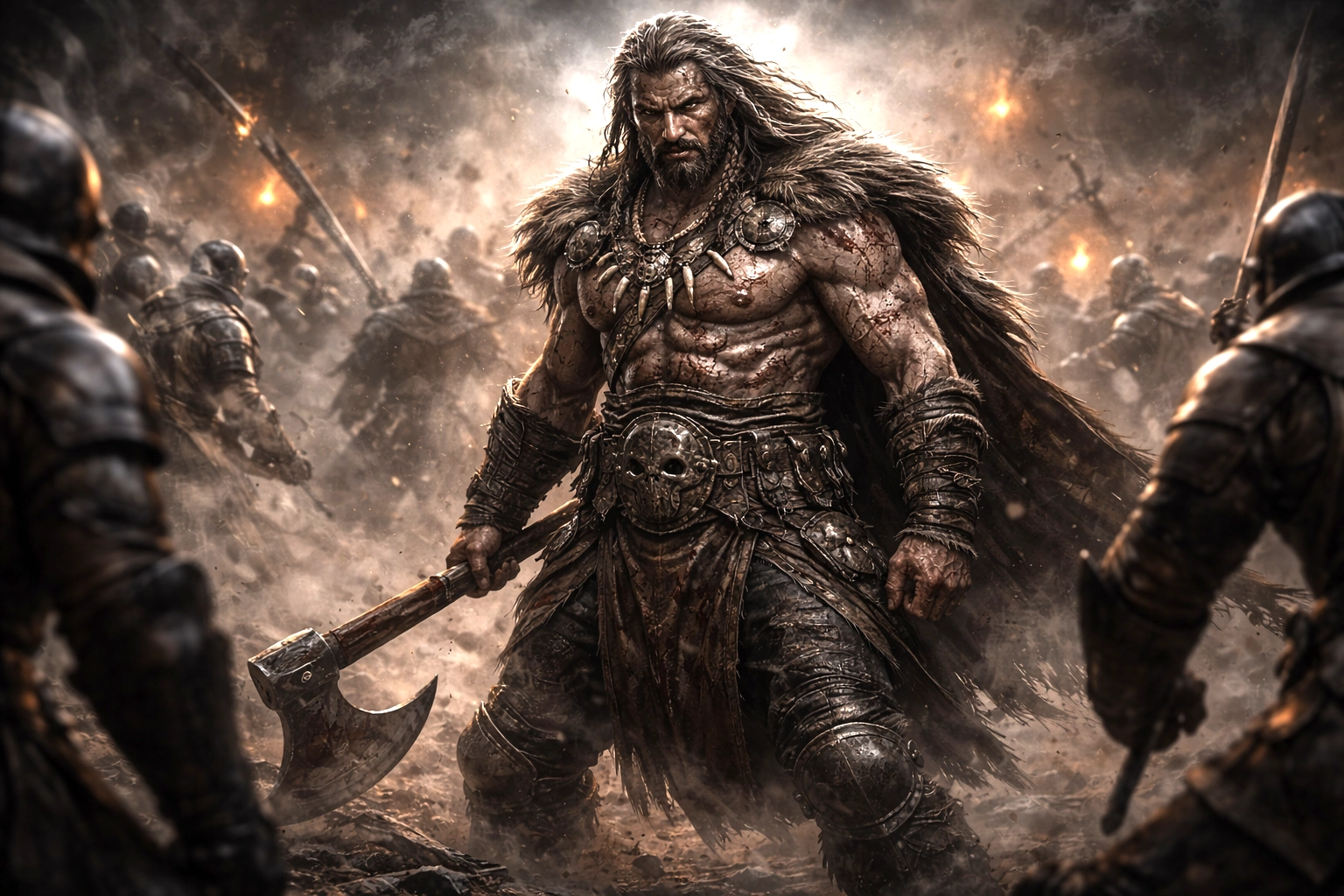
There’s a version of the Barbarian that exists mostly in highlight reels. It charges; it rages. It swings recklessly every turn until something drops. And for a session or two? That works. But over the course of a campaign, through long travel days, uneven encounters, attrition, bad positioning, and smarter enemies, that version starts to crack.
This article is about the Barbarian that doesn’t. It’s not the loudest, it’s not the flashiest, but it’s the one that is still standing when the fight turns.
Building Better Characters
Great characters aren’t built in a single step; they’re shaped over time.
This three-part series explores how to create a character that not only works on paper, but thrives across an entire campaign:
Part 1: Smart Mechanical Choices That Scale
Part 2: Meaningful Character Identity That Drives Play
Part 3: Table Integration and Long-Term Character Success
Start where you are, or follow the full journey.
The Campaign Reality of the Barbarian
The Barbarian’s reputation is simple: big damage, big health, low complexity. The reality at the table is more nuanced. Barbarians succeed or fail based on three quiet decisions: when you Rage, when you go Reckless, and where you stand. Get those things right, and you’re the party’s anchor; get them wrong, and you burn out early, get focused down, or drift out of relevance.
“Barbarians don’t fail because they’re weak; they fail because they’re played like they’re invincible.”
Under the 2024 rules, the Barbarian is in a strong place, but only if you lean into what it actually does well: Consistency. Pressure. Durability. Not: burst, tricks, and gimmicks.
What This Build Is (and isn’t)
This is: Durable, consistent, campaign-stable.
This is not: Nova burst, crit-fishing, or gimmick stacking
Goal: Be the character still standing when the fight turns
The Build: Sustained Rage Bruiser
This is the Barbarian that scales cleanly from Level 1 through Tier 2 without needing fixes, dips, or patchwork.
Role at the Table: Frontline anchor and pressure engine
What It Does Best:
- Absorbs damage without collapsing
- Applies steady, reliable melee pressure
- Forces enemies to commit resources inefficiently
What It Avoids:
- Bonus action clutter
- Over-specialization (grapple-only, crit-fishing, etc.)
- “All gas, no brakes” Reckless play
This build doesn’t spike; it endures.
Core Loop: Simple, Stable, Repeatable
A good Barbarian turn should feel almost boring. That’s a compliment.
Round 1
- Bonus Action: Rage
- Action: Attack (Reckless only if warranted)
Rounds 2+
- Maintain Rage through engagement
- Attack (Extra Attack at Level 5)
- Apply weapon mastery effects where relevant
- Use reaction if your subclass or positioning allows
That’s it.
No setup turn, no fragile combo, no resource juggling beyond Rage.
If your Barbarian needs three steps to function, something has gone wrong.
At the Table
Most Barbarian turns should resolve quickly. If your turn regularly slows down the table, reassess:
- Are you overusing grapples?
- Are you overthinking Reckless Attack?
- Are you trying to “optimize” instead of apply pressure?
Fast turns equals more pressure over time.
Ability Scores That Actually Scale
Barbarians are one of the easiest classes to mis-prioritize. The temptation? Stack Constitution and call it a day. The reality? You need to hit hard enough to matter, or enemies will simply ignore you.
“Durability keeps you alive. Damage makes you matter.”
Point Buy Foundation
Before Background bonuses:
| STR | CON | DEX | WIS | INT | CHA |
|---|---|---|---|---|---|
| 15 | 15 | 14 | 11 | 8 | 9 |
After Background:
- STR 17
- CON 16
- DEX 14
This gives you:
- Immediate frontline credibility
- Strong AC via Unarmored Defense (or flexibility into medium armor)
- Clean scaling into your first ASI
Standard Array Option
| STR | CON | DEX | WIS | INT | CHA |
|---|---|---|---|---|---|
| 15 | 14 | 13 | 12 | 8 | 10 |
After Background:
- STR 17
- CON 15
- DEX 14
Slightly softer early, but still stable and reliable.
Backgrounds That Pull Their Weight
With 2024 rules tying ability boosts to Backgrounds, this choice matters more than ever. You’re not just picking flavor; you’re locking in your early math.
Strong Fits
- Soldier: Clean STR/CON synergy, Athletics support
- Outlander: Adds WIS support and exploration value
- Guard: Reinforces frontline identity
- Wayfarer: Useful if you want a touch more mobility and adaptability
2024 Character Creation Note
In the 2024 rules, your Background defines your starting ability boosts. For Barbarians, this means:
- Your Strength progression starts here, not at Level 4
- A weak Background choice delays your entire build
This is no longer just flavor. It’s your foundation.
What you’re looking for:
- Strength support
- Athletics proficiency
- No pressure into off-stat investment
What you’re avoiding:
- Charisma-driven builds
- Spellcasting hooks
- Anything that competes for your bonus action
Subclass Choice: Path of the World Tree
This is where the 2024 Barbarian quietly shines.
Path of the World Tree reinforces everything the Barbarian already wants to do, without overcomplicating it.
Why It Works in a Campaign
- Adds survivability without new resource strain
- Improves positioning and battlefield presence
- Supports the party without stealing spotlight bandwidth
- Avoids bonus action congestion
“The best subclass doesn’t change your job. It helps you do it better.”
It doesn’t ask you to play differently; it makes what you’re already doing better.
A Note on Berserker (2024)
The reworked Berserker is dramatically improved and absolutely playable. But it still nudges players toward: over-aggression, resource mismanagement, “always on” offense. For a campaign-stable build, World Tree remains the cleaner choice.
Weapon Strategy (2024 Considerations)
Weapon Mastery in 2024 adds subtle, but important, texture to Barbarian play. You’re not just swinging anymore. You’re shaping the fight.
Look for weapons that:
- Reinforce control (push, topple, cleave-style effects)
- Don’t require complex setup
- Work cleanly with Extra Attack
Avoid overly conditional weapons that require:
- Specific positioning every turn
- Bonus action chaining
- Target-type dependency
You want reliability, not a puzzle.
Weapon Check
Choose weapons that
- Work every round without setup
- Add control without extra actions
- Scale cleanly with Extra Attack
Avoid weapons that
- Only shine in “perfect” scenarios
- Require positioning gimmicks
- Compete for your bonus action
Scaling Through Tier 1 → Tier 2
This build scales because it doesn’t change what it’s trying to do.
Levels 1-4
- Rage is limited, so use it intentionally
- You are durable, but not immortal
- Positioning matters more than aggression
Levels 5-7
- Extra Attack stabilizes your output
- Your presence becomes consistent, not swingy
- You start shaping encounters instead of reacting to them
Levels 8-10
- You are now a true frontline anchor
- Enemies must deal with you, or suffer for ignoring you
- Your value is measured in rounds survived and pressure maintained
The Barbarian doesn’t peak early. It settles in.
The Biggest Trap: Reckless Every Turn
Reckless Attack is one of the most misunderstood features in the game.
Used well, it secures hits when you need them, enables critical moments, and turns key rounds in your favor. Used poorly, it paints a target on you every round, multiplies incoming damage, and burns through your durability faster than Rage can compensate.
The campaign-ready Barbarian asks: Is this the round I need advantage?
Not: Why wouldn’t I?
Table Mistake: Reckless Every Turn
Use it When
- You can afford the return damage
- You need a hit to land
- The fight swings on this round
Avoid Using it When
- The fight is already under control
- You’re already being focused
- You’re low on HP
Reckless is a decision, not a habit.
Other Mechanical Traps to Avoid
Bonus Action Creep
Your bonus action is already spoken for: Rage. Don’t stack feats that require constant bonus action use, or build toward off-class mechanics that compete here.
Grapple Fixation
Grappling is a tool, not a lifestyle. Overuse leads to lost damage, slower fights, and broken pacing. Use it when it matters. Then go back to hitting things.
Overstacking Constitution Early
Yes, more HP feels good. But damage is threat and threat is relevance. A Barbarian who can’t pressure enemies gets ignored.
Reaction Competition
If your subclass offers reaction options, don’t stack competing reaction features. Pick a lane.
“A Barbarian who tries to do everything ends up doing nothing well.”
What This Barbarian Feels Like at the Table
This build doesn’t dominate the spotlight. It controls the rhythm of the fight so that you’re the one still standing when others fall back; you’re the reason enemies can’t freely reposition. you’re the pressure that never quite goes away
You don’t win encounters in one turn. You win them by still being there in round five.
“In a real campaign, consistency beats spectacle. Every time.”
Campaign-Ready Barbarian Snapshot
- Role: Frontline anchor
- Strength: Consistent pressure + durability
- Weakness: Vulnerable to overextension
- Playstyle: Controlled aggression, not constant aggression
- Key Skill: Knowing when not to go Reckless
Final Thought
The best Barbarian isn’t the one who hits the hardest. It’s the one the DM can’t ignore; and can’t remove. Because in a real campaign, consistency beats spectacle.
Every time.
Find Your Role at the Table
Every class in D&D answers a different question:
- Who holds the line? → Fighter
- Who rewrites the rules? → Wizard
- Who applies pressure? → Barbarian
- Who keeps the party standing? → Cleric
- Who hunts and controls the edges of the fight? → Ranger
- Who strikes at the perfect moment? → Rogue
- Who leads from the front with purpose and presence? → Paladin
- Who adapts with nature and flexibility? → Druid
- Who trades risk for power? → Warlock
- Who channels raw magic into explosive potential? → Sorcerer
- Who controls the flow of combat through movement and discipline? → Monk
- Who elevates the entire party? → Bard
This series is built to help you choose more than a class; it helps you choose how you show up at the table.