Homebrew • DM Tips • Scaling
Scaling Encounters Without Breaking Your Party
Smarter Ways to Increase Challenge Without Inflating Hit Points
There’s a moment every DM hits.
You look down at the battlefield and realize one of two things:
- The party is about to steamroll your “big” encounter.
- Or you just accidentally built a TPK machine.
Neither feels great.
Over the last few campaigns, I’ve had to scale encounters constantly, not by rebuilding stat blocks from scratch, but by adjusting how the fight behaves. What I’ve learned is this:
Scaling safely isn’t just about adding more hit points. It’s about controlling pressure.
Let’s talk about how to do that without breaking your party.
“If you want to scale an encounter safely, don’t add hit points. Add pressure.”
Stop Adding Hit Points. Start Adding Actions.
If you take nothing else from this article, take this:
Action economy wins fights.
Four goblins are often scarier than one ogre. Not because of damage. Because of turns.
More turns means:
- More attack rolls
- More chances to crit
- More battlefield control
- More chaos
If an encounter feels too easy, your first instinct shouldn’t be “double the boss’s HP.”
Instead, ask:
- Does the enemy need allies?
- Does it need a reaction?
- Does it need something to do off-turn?
Scaling Outward (More Bodies)
Adding minions is the cleanest scaling tool in the box.
Minions:
- Spread damage around.
- Force target prioritization.
- Protect leaders.
- Complicate positioning.
And if things get too dangerous? You can always have fewer reinforcements arrive.
Scaling Upward (More Things to Do)
If you don’t want to clutter the field, give a creature:
- A bonus action shove
- A reaction attack
- A once-per-round special move
- A battlefield-triggered action (think “lair action lite”)
You’re not rewriting the stat block. You’re giving the creature presence.
“Four goblins with turns are often scarier than one ogre with hit points.”
Pack Tactics Without Breaking the Game
This is where we can bridge new and experienced DMs.
Giving low-level enemies Pack Tactics (or advantage-like mechanics) increases their hit rate without inflating their damage dice. It makes them feel coordinated and dangerous, even when their stats look unimpressive.
But you don’t have to jump straight to full Pack Tactics.
Here’s a sliding scale:
Beginner:
Grant advantage only when two enemies are clearly flanking the same target.
Intermediate:
Grant advantage in round one if the party is outnumbered.
Advanced:
Full Pack Tactics for trained soldiers, bandits, or goblins fighting as a unit.
The key is intent. You’re not making them stronger, you’re making them work together.
That looks deceptively easy on paper. At the table? It gets tense fast.
Terrain Is Invisible Hit Points
Want to scale an encounter without touching the stat block?
Change the room.
Terrain is the most underused difficulty dial in the game.
Instead of boosting numbers, try adding:
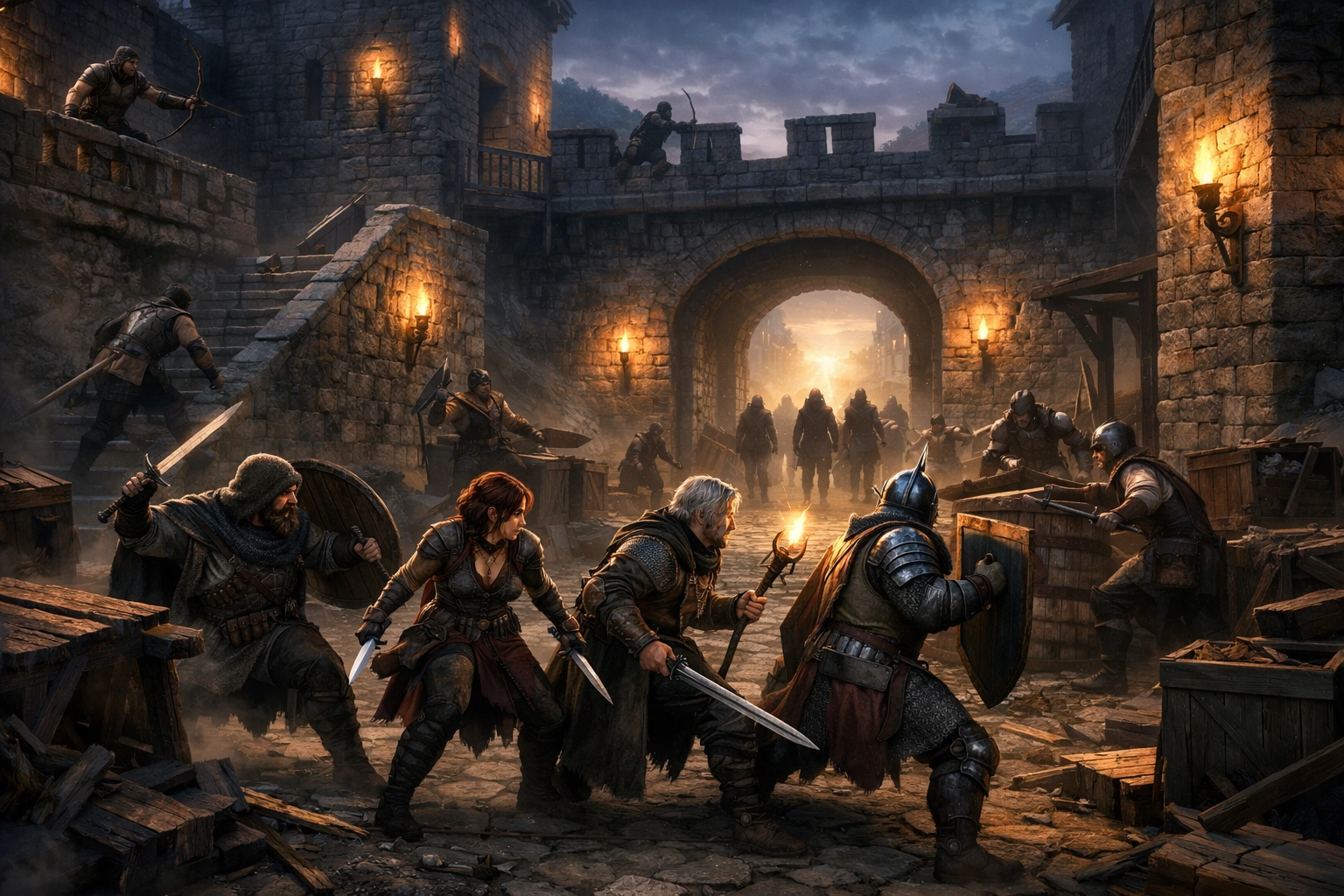
- Heavy furniture for cover
- Narrow bridges or staircases
- Elevated archers
- Collapsing scaffolds
- Fires spreading mid-fight
- Innocent NPCs caught in the chaos
- A ritual circle that must be disrupted
None of that increases raw damage, but it increases decisions. And decisions are what make fights feel hard.
Good terrain forces:
- Movement.
- Trade-offs.
- Split focus.
- Risk assessment.
You don’t need more HP when the battlefield is doing the work for you.
“Terrain is invisible hit points.”
Send Them in Waves
Waves are one of the safest scaling tools you can use. Because you can stop.
“Waves are powerful because you can stop.”
Instead of throwing eight enemies on the map at once, send three and see how the party handles it.
If they’re cruising? Reinforcements arrive.
If they’re struggling? The backup never makes it through the door.
Telegraph It or Surprise Them?
Telegraphing builds tension.
- Distant horn blasts.
- Footsteps in the hallway.
- An enemy shouting for help.
- A shadow circling overhead.
Players feel smart when they prepare.
Surprise waves create adrenaline.
- Enemies crashing through windows.
- Bursting from trapdoors.
- Dropping from rooftops.
Both work. Just know the tone you want.
Add a Flyby Threat
Sometimes the best way to scale a fight isn’t more enemies, it’s chaos. Introduce a powerful creature that doesn’t fully commit.
A dragon flies overhead and strafes the street. A war machine fires blindly into the fray. A collapsing tower sends debris raining down.
The key? It affects everyone.
Suddenly the battlefield shifts. Both sides reposition. The fight becomes dynamic instead of static.
It raises tension without simply increasing lethality.
Experiment With Grouped Initiative
This one is theoretical for me, but promising.
Instead of strict individual initiative, try grouping:
- Highest two players act together.
- Next two act together.
- Enemies interspersed between groups.
What does this change?
- Combat moves faster.
- Players coordinate more.
- Engagement increases.
It doesn’t necessarily increase difficulty, it increases volatility.
Alpha strikes become stronger. Teamwork becomes critical.
If you try this, test it in a low-stakes encounter first. It’s a pacing tool more than a difficulty dial, but it can absolutely change how combat feels.
Scale Objectives, Not Damage
This might be the cleanest scaling method of all.
Instead of asking “How do I make this fight harder?”
Ask: “What are they trying to accomplish?”
Try:
- Hold the gate for five rounds.
- Stop the ritual before it completes.
- Rescue the hostage before reinforcements arrive.
- Escape before the building collapses.
You didn’t increase enemy HP, you increased pressure. And pressure creates drama without creating a TPK.
About Hit Points (Yes, I Adjust Them)
Let’s talk about it.
I will occasionally adjust hit points behind the screen.
Not to save villains. Not to punish players. And not to override dice rolls.
But if the final blow lands for 49 damage and the creature has 51 HP left?
It’s over.
That’s not fudging dice. That’s closing a scene cleanly.
On the flip side, if the party obliterates what was meant to be a climactic foe in round one, sometimes that enemy gets one last moment.
Used sparingly, this protects pacing. Used constantly, it destroys trust.
Know the difference.
“Adjust outcomes sparingly. Protect pacing fiercely.”
Want Ready-Made Examples?
If you’d rather see these principles applied instead of building from scratch:
- Check out Scaling Creatures Without Rebuilding Stat Blocks.
- Explore ready-to-run urban creature tools.
- Look at encounter design frameworks that build tension without bloating HP totals.
You don’t always need bigger numbers, but you could use smarter pressure.
Encounters don’t break parties because they’re too strong. They break parties because they’re inflexible.
When you scale actions, terrain, pacing, and objectives instead of just hit points, you gain control.
And control is what keeps your players challenged, and alive.